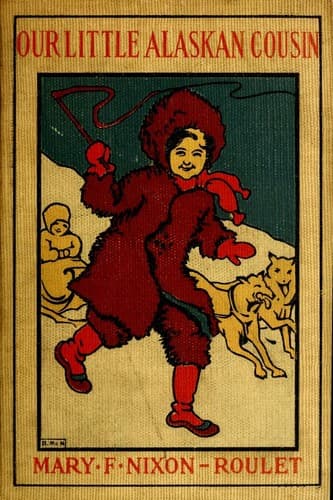
Kalitan, Our Little Alaskan CousinNixon-Roulet, Mary F.
General
Kalitan, Our Little Alaskan Cousin
Nixon-Roulet, Mary F.
Children -- Alaska -- Juvenile literature
"It has always been admired because it is so warm and soft," replied Mr.
Strong. "All the ladies fancy it, and it never seems to go out of
fashion. There was a time, when the Pribylov Islands were first
discovered, that sealskins were so plentiful that they sold in Alaska
for a dollar apiece. Hunters killed so many, killing old and young, that
soon there were scarcely any left, so a law was passed by the Russian
government forbidding any killing for five years. Since the Americans
have owned Alaska they have protected the seals, allowing them to be
killed only at certain times, and only male seals from two to four years
old are killed. The Indians are always the killers, and are wonderfully
swift and clever, never missing a blow and always killing instantly, so
that there is almost no suffering."
"How do they know where to find the seals?" asked Ted.
"For half the year the seals swim about the sea, but in May they return
to their favourite haunts. In these rookeries families of them herd on
the rocks, the male staying at home with his funny little black
puppies, while the mother swims about seeking food. The seals are very
timid, and will rush into the water at the least strange noise. A story
is told that the barking of a little pet dog belonging to a Russian at
one of the rookeries lost him a hundred thousand dollars, for the seals
took fright and scurried away before any one could say 'Jack Robinson!'"
"Rather an expensive pup!" commented Ted. "But what about the seals,
daddy?"
"You seem to think I am an encyclopædia on the seal question," said his
father. "There is not much else to tell you."
"How can they manage always to kill the right ones?" demanded Ted.
"The gay bachelor seals herd together away from the rest and sleep at
night on the rocks. Early in the morning the Aleuts slip in between them
and the herd and drive them slowly to the killing-ground, where they are
quickly killed and skinned and the skins taken to the salting-house.
The Indians use the flesh and blubber, and the climate is such that
before another year the hollow bones are lost in the grass and earth."
"What becomes of the skins after they are salted?"
"They are usually sent to London, where they are prepared for market.
The work is all done by hand, which is one reason that they are so
expensive. They are first worked in sawdust, cleaned, scraped, washed,
shaved, plucked, dyed with a hand-brush from eight to twelve times,
washed again and freed from the least speck of grease by a last bath in
hot sawdust or sand."
"I don't wonder a sealskin coat costs so much," said Ted, "if they have
got to go through all that performance. I wish we could have seen the
islands, but I'd hate to see the seals killed. It doesn't seem like
hunting just to knock them on the head. It's too much like the
stock-yards at home."
"Yes, but it's a satisfaction to know that it's done in the easiest
possible way for the animals.
Public-domain text, read in full here on John Shaqi.
Reviews
Reviews
No reviews yet
Be the first to share your thoughts on this work.
Join the Discussion
Join the discussion
Sign in to leave a comment or review.
Sign InorCreate an account