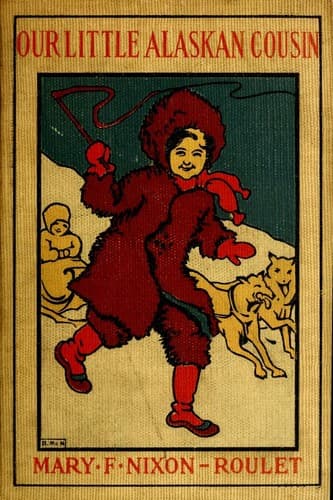
Kalitan, Our Little Alaskan CousinNixon-Roulet, Mary F.
General
Kalitan, Our Little Alaskan Cousin
Nixon-Roulet, Mary F.
Children -- Alaska -- Juvenile literature
They climbed down the ladder, crawled along the narrow passage to where
a skin hung before an opening, and, pushing it aside, entered the
living-room. Here they found an old man busily engaged in carving a
walrus tooth, another sewing _mukluks_, while a girl was singing a
quaint lullaby to a child of two in the corner.
The young girl rose, and, putting the baby down on a pile of skins,
spoke to them in good English, saying quietly:
"You are welcome. I am Alalik."
"May we see your wares? We wish to buy," said Mr. Strong, courteously.
"You may see, whether you buy or not," she said, with a smile, which
showed a mouth full of even white teeth, and she spread out before them
a collection of Esquimo goods. There were all kinds of carvings from
walrus tusks, grass baskets, moccasins of walrus hide, stone bowls and
cups, _parkas_ made of reindeer skin, and one superb one of bird
feathers, _ramleikas_, and all manner of carved trinkets, the most
charming of which, to Ted's eyes, being a tiny _oomiak_ with an Esquimo
in it, made to be used as a breast-pin. This he bought for his mother,
and a carving of a baby for Judith; while his father made him and
Kalitan happy with presents.
"Where did you learn such English?" asked Mr. Strong of Alalik,
wondering, too, where she learned her pretty, modest ways, for Esquimo
women are commonly free and easy.
"I was for two years at the Mission at Holy Cross," she said. "There I
learned much that was good. Then my mother died, and I came home."
She spoke simply, and Mr. Strong wondered what would be the fate of this
sweet-faced girl.
"Did you learn to sew from the sisters?" asked Ted, who had been looking
at the garments she had made, in which the stitches, though made in
skins and sewn with deer sinew, were as even as though done with a
machine.
"Oh, no," she said. "We learn that at home. When I was no larger than
Zaksriner there, my mother taught me to braid thread from deer and whale
sinew, and we must sew very much in winter if we have anything to sell
when summer comes. It is very hard to get enough to live. Since the
Boston men come, our people waste the summer in idleness, so we have
nothing stored for the winter's food. Hundreds die and many sicknesses
come upon us. In the village where my people lived, in each house lay
the dead of what the Boston men called measles, and there were not left
enough living to bury the dead. Only we escaped, and a Black Gown came
from the Mission to help, and he took me and Antisarlook, my brother, to
the school. The rest came here, where we live very well because there
are in the summer, people who buy what we make in the winter."
"How do you get your skins so soft?" asked Ted, feeling the exquisite
texture of a bag she had just finished. It was a beautiful bit of work,
a tobacco-pouch or "Tee-rum-i-ute," made of reindeer skin, decorated
with beads and the soft creamy fur of the ermine in its summer hue.
Public-domain text, read in full here on John Shaqi.
Reviews
Reviews
No reviews yet
Be the first to share your thoughts on this work.
Join the Discussion
Join the discussion
Sign in to leave a comment or review.
Sign InorCreate an account