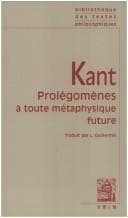
Kant's Prolegomena to Any Future Metaphysics — John Shaqi
Kant's Prolegomena to Any Future MetaphysicsKant, Immanuel
PhilosophyPhilosophy
Kant's Prolegomena to Any Future Metaphysics
Kant, Immanuel
Knowledge, Theory of -- Early works to 1800; Metaphysics -- Early works to 1800
===================================
{8} The term apodeictic is borrowed by Kant from Aristotle who uses it
in the sense of "certain beyond dispute." The word is derived from
ἀποδείκνυμι (= I show) and is contrasted to dialectic
propositions, i.e., such statements as admit of controversy.—Ed.
===================================
§ 3. A Remark on the General Division of Judgments into Analytical
and Synthetical.
This division is indispensable, as concerns the Critique of human
understanding, and therefore deserves to be called classical, though
otherwise it is of little use, but this is the reason why dogmatic
philosophers, who always seek the sources of metaphysical judgments in
Metaphysics itself, and not apart from it, in the pure laws of reason
generally, altogether neglected this apparently obvious distinction.
Thus the celebrated Wolf, and his acute follower Baumgarten, came to
seek the proof of the principle of Sufficient Reason, which is clearly
synthetical, in the principle of Contradiction. In Locke's Essay,
however, I find an indication of my division. For in the fourth book
(chap. iii. § 9, seq.), having discussed the various connexions of
representations in judgments, and their sources, one of which he makes
"identity and contradiction" (analytical judgments), and another the
coexistence of representations in a subject, he confesses (§ 10) that
our a priori knowledge of the latter is very narrow, and almost
nothing. But in his remarks on this species of cognition, there is so
little of what is definite, and reduced to rules, that we cannot
wonder if no one, not even Hume, was led to make investigations
concerning this sort of judgments. For such general and yet definite
principles are not easily learned from other men, who have had them
obscurely in their minds. We must hit on them first by our own
reflexion, then we find them elsewhere, where we could not possibly
have found them at first, because the authors themselves did not know
that such an idea lay at the basis of their observations. Men who
never think independently have nevertheless the acuteness to discover
everything, after it has been once shown them, in what was said long
since, though no one ever saw it there before.
§ 4. The General Question of the Prolegomena.—Is Metaphysics at all
Possible?
Public-domain text, read in full here on John Shaqi.
Reviews
Reviews
No reviews yet
Be the first to share your thoughts on this work.
Join the Discussion
Join the discussion
Sign in to leave a comment or review.
Sign InorCreate an account