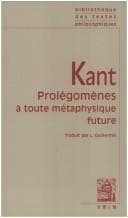
Kant's Prolegomena to Any Future MetaphysicsKant, Immanuel
PhilosophyPhilosophy
Kant's Prolegomena to Any Future Metaphysics
Kant, Immanuel
Knowledge, Theory of -- Early works to 1800; Metaphysics -- Early works to 1800
Were a metaphysics, which could maintain its place as a science,
really in existence; could we say, here is metaphysics, learn it, and
it will convince you irresistibly and irrevocably of its truth: this
question would be useless, and there would only remain that other
question (which would rather be a test of our acuteness, than a proof
of the existence of the thing itself), "How is the science possible,
and how does reason come to attain it?" But human reason has not been
so fortunate in this case. There is no single book to which you can
point as you do to Euclid, and say: This is Metaphysics; here you may
find the noblest objects of this science, the knowledge of a highest
Being, and of a future existence, proved from principles of pure
reason. We can be shown indeed many judgments, demonstrably certain,
and never questioned; but these are all analytical, and rather concern
the materials and the scaffolding for Metaphysics, than the extension
of knowledge, which is our proper object in studying it (§ 2). Even
supposing you produce synthetical judgments (such as the law of
Sufficient Reason, which you have never proved, as you ought to, from
pure reason a priori, though we gladly concede its truth), you lapse
when they come to be employed for your principal object, into such
doubtful assertions, that in all ages one Metaphysics has contradicted
another, either in its assertions, or their proofs, and thus has
itself destroyed its own claim to lasting assent. Nay, the very
attempts to set up such a science are the main cause of the early
appearance of scepticism, a mental attitude in which reason treats
itself with such violence that it could never have arisen save from
complete despair of ever satisfying our most important aspirations.
For long before men began to inquire into nature methodically, they
consulted abstract reason, which had to some extent been exercised by
means of ordinary experience; for reason is ever present, while laws
of nature must usually be discovered with labor. So Metaphysics
floated to the surface, like foam, which dissolved the moment it was
scooped off. But immediately there appeared a new supply on the
surface, to be ever eagerly gathered up by some, while others, instead
of seeking in the depths the cause of the phenomenon, thought they
showed their wisdom by ridiculing the idle labor of their neighbors.
The essential and distinguishing feature of pure mathematical
cognition among all other a priori cognitions is, that it cannot at
all proceed from concepts, but only by means of the construction of
concepts (see Critique II., Method of Transcendentalism, chap. I.,
sect. 1). As therefore in its judgments it must proceed beyond the
concept to that which its corresponding visualisation (Anschauung)
contains, these judgments neither can, nor ought to, arise
analytically, by dissecting the concept, but are all synthetical.
Public-domain text, read in full here on John Shaqi.
Reviews
Reviews
No reviews yet
Be the first to share your thoughts on this work.
Join the Discussion
Join the discussion
Sign in to leave a comment or review.
Sign InorCreate an account