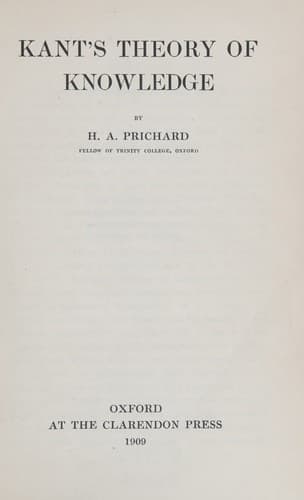
Kant's Theory of KnowledgePrichard, H. A. (Harold Arthur)
Philosophy
Kant's Theory of Knowledge
Prichard, H. A. (Harold Arthur)
Kant, Immanuel, 1724-1804; Knowledge, Theory of
[3] For the sake of uniformity _Vorstellung_ has throughout
been translated by 'representation', though sometimes, as in
the present passage, it would be better rendered by
'presentation'.
[4] B. 74-5, M. 45-6.
The distinction so stated appears straightforward and, on the
whole,[5] sound. And it is fairly referred to by Kant as the
distinction between the faculties of perceiving and conceiving or
thinking, provided that the terms perceiving and conceiving or
thinking be taken to indicate a distinction within perception in the
ordinary sense of the word. His meaning can be stated thus: 'All
knowledge requires the realization of two conditions; an individual
must be presented to us in perception, and we as thinking beings must
bring this individual under or recognize it as an instance of some
universal. Thus, in order to judge 'This is a house' or 'That is red'
we need the presence of the house or of the red colour in perception,
and we must 'recognize' the house or the colour, i. e. apprehend the
individual as a member of a certain kind. Suppose either condition
unrealized. Then if we suppose a failure to conceive, i. e. to
apprehend the individual as a member of some kind, we see that our
perception--if it could be allowed to be anything at all--would be
blind i. e. indeterminate, or a mere 'blur'. What we perceived would
be for us as good as nothing. In fact, we could not even say that we
were perceiving. Again, if we suppose that we had merely the
conception of a house, and neither perceived nor had perceived an
individual to which it applied, we see that the conception, being
without application, would be neither knowledge nor an element in
knowledge. Moreover, the content of a conception is derived from
perception; it is only through its relation to perceived individuals
that we become aware of a universal. To know the meaning of 'redness'
we must have experienced individual red things; to know the meaning of
'house' we must at least have had experience of individual men and of
their physical needs. Hence 'conceptions' without 'perceptions' are
void or empty. The existence of conceptions presupposes experience of
corresponding individuals, even though it also implies the activity of
thinking in relation to these individuals.'[6]
[5] Cf. p. 29, note 1.
[6] Kant's account implies that he has in view only empirical
knowledge; in any case it only applies to empirical
conceptions.
Public-domain text, read in full here on John Shaqi.
Reviews
Reviews
No reviews yet
Be the first to share your thoughts on this work.
Join the Discussion
Join the discussion
Sign in to leave a comment or review.
Sign InorCreate an account