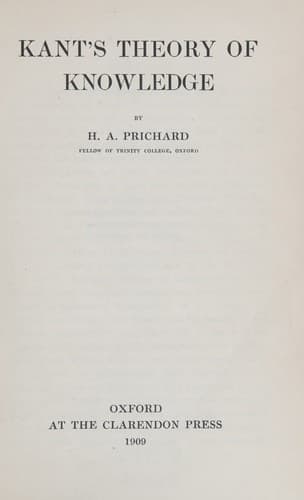
Kant's Theory of KnowledgePrichard, H. A. (Harold Arthur)
Philosophy
Kant's Theory of Knowledge
Prichard, H. A. (Harold Arthur)
Kant, Immanuel, 1724-1804; Knowledge, Theory of
Further, it is true to say that as perceiving we are passive; we do
not do anything. This, as has been pointed out, is the element of
truth contained in the statement that objects are _given_ to us. On
the other hand, it may be truly said that as conceiving, in the sense
of bringing an individual under a universal, we are essentially
active. This is presupposed by the notice or attention involved in
perception ordinarily so called, i. e. perception in the full sense
in which it includes conceiving as well as perceiving.[7] Kant,
therefore, is justified in referring to the sensibility as a
'receptivity' and to the understanding as a 'spontaneity'.
[7] This distinction within perception is of course
compatible with the view that the elements so distinguished
are inseparable.
The distinction, so stated, appears, as has been already said,
intelligible and, in the main[8], valid. Kant, however, renders the
elucidation of his meaning difficult by combining with this view of
the distinction an incompatible and unwarranted theory of perception.
He supposes,[9] without ever questioning the supposition, that
perception is due to the operation of things outside the mind, which
act upon our sensibility and thereby produce sensations. On this
supposition, what we perceive is not, as the distinction just stated
implies, the thing itself, but a sensation produced by it.
Consequently a problem arises as to the meaning on this supposition of
the statements 'by the sensibility objects are given to us' and 'by
the understanding they are thought'. The former statement must mean
that when a thing affects us there is a sensation. It cannot mean that
by the sensibility we know that there exists a thing which causes the
sensation, for this knowledge would imply the activity of thinking;
nor can it mean that in virtue of the sensibility the thing itself is
presented to us. The latter statement must mean that when sensation
arises, the understanding judges that there is something causing it;
and this assertion must really be _a priori_, because not dependent
upon experience. Unfortunately the two statements so interpreted are
wholly inconsistent with the account of the functions of the
sensibility and the understanding which has just been quoted.
[8] See p. 29, note 1.
[9] Cf. B. 1, M. 1.
Public-domain text, read in full here on John Shaqi.
Reviews
Reviews
No reviews yet
Be the first to share your thoughts on this work.
Join the Discussion
Join the discussion
Sign in to leave a comment or review.
Sign InorCreate an account