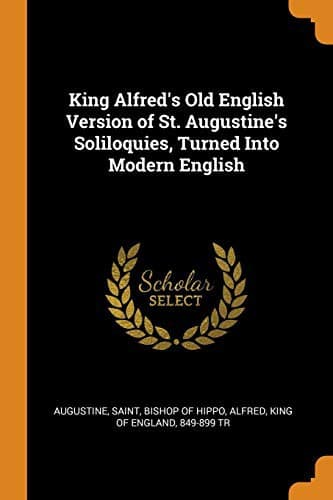
King Alfred's Old English Version of St. Augustine's Soliloquies: Turned into Modern EnglishAugustine, of Hippo, Saint
ReligionChristian
King Alfred's Old English Version of St. Augustine's Soliloquies: Turned into Modern English
Augustine, of Hippo, Saint
Knowledge, Theory of (Religion) -- Early works to 1800
_R._ _I wonder why thou speakest so. Suppose now if a letter with seal
from thy lord should come to thee, canst thou say thou art not able to
understand him by that, nor to recognise his will therein? If thou
sayest that thou canst know his will therein, say then whether it
seemeth to thee better to follow his will, or to follow after the wealth
which he gave thee over and above his friendship._
_A._ _Whether I will or not, I must speak truly, unless I am prepared to
lie. If I lie, God knoweth it. Therefore I dare speak only the truth, so
far as I can know it. Methinks it is better to forsake the gift, and
follow the giver, who is to me the steward both of the riches and of his
friendship, unless I can have both. I should like, however, to have
both, if I could follow both the wealth and also his will._
[Sidenote: 24.7--25.23]
_R._ _Full rightly hast thou answered me, but I would ask thee whether
thou supposest that thou canst have all that thou now hast without thy
lord's friendship._
_A._ _I do not suppose that any man is so foolish as to think that._
_R._ _Thou understandest it rightly enough, but I would know whether
thou thinkest that what thou hast is temporal or eternal._
_A._ _I never supposed it to be eternal._
_R._ _What thinkest thou about God and the anchors which we spake
of--are they like these, or are they eternal?_
_A._ _Who is so mad as to dare say that God is not eternal?_
_R._ _If He is eternal, why lovest thou not the eternal Lord more than
the temporal? Lo, thou knowest that the Eternal will not leave thee,
except thou go from Him; and thou must needs depart from the other
whether thou will or no; thou must either leave him, or he thee. Howbeit
I perceive that thou lovest him very much, and also fearest and dost
well; very rightly and very becomingly thou dost. But I wonder why thou
dost not love the Other much more, Him who giveth thee both the
friendship of the worldly lord and His own, and, after this world, life
eternal. The Lord is the ruler of you both--thine and thy lord's whom
thou so immeasurably lovest._
_A._ _I confess to thee that I would love Him above all other things, if
I could understand and know Him as I would. But I can understand very
little of Him, or nothing at all, and yet at times, when I think
carefully of Him, and any inspiration cometh to me about the eternal
life, then I by no means prefer this present life to that, nor even love
it so much._
_R._ _Wishest thou now to see Him and clearly understand Him?_
_A._ _I have no wish above that._
_R._ _Keep, then, His commandments._
[Sidenote: 25.24--27.13]
_A._ _What commandments?_
_R._ _I named them to thee before._
_A._ _Methinks they are very burdensome and very manifold._
_R._ _What one loveth, methinks, is not burdensome._
_A._ _Nor doth any work seem burdensome to me if I can see and have what
I work for. But doubt begetteth heaviness._
Public-domain text, read in full here on John Shaqi.
Reviews
Reviews
No reviews yet
Be the first to share your thoughts on this work.
Join the Discussion
Join the discussion
Sign in to leave a comment or review.
Sign InorCreate an account