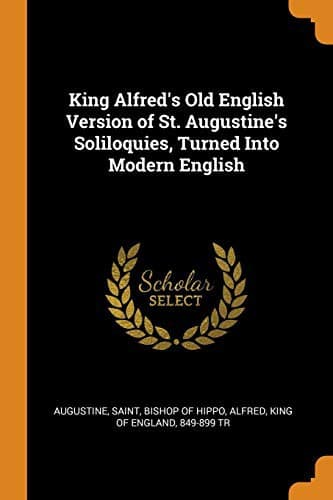
King Alfred's Old English Version of St. Augustine's Soliloquies: Turned into Modern English — John Shaqi
King Alfred's Old English Version of St. Augustine's Soliloquies: Turned into Modern EnglishAugustine, of Hippo, Saint
ReligionChristian
King Alfred's Old English Version of St. Augustine's Soliloquies: Turned into Modern English
Augustine, of Hippo, Saint
Knowledge, Theory of (Religion) -- Early works to 1800
_A._ Alas! what a hard thing thou dost enjoin upon me! _Didst thou not
formerly admit that I loved nothing above wisdom, and moreover I too
admitted it, albeit thou saidst then that_ whoever loveth one thing for
the sake of another, he doth not of a truth love that former thing for
which he professeth love, _but really that for which he loved the former
thing and thought to obtain it_. Therefore I assert that I love wisdom
for no other thing than for its own sake. I love all the world--each
thing as I consider it profitable, and especially that thing most which
helpeth me to wisdom; and moreover those things which I fear most to
lose. Howbeit I do not love any thing else in such wise as I love
wisdom. Every thing which I love most I grant, while I love it most, to
no man but to myself, _except wisdom alone_. It I love above all other
things, and yet of my free will I would grant it to every man, so that
all who are on this earth might love it and search after it, yea, find
it, and then use it; for I know that each of us would love the other by
so much more as our will and our love were more in unison.
[Sidenote: 43.13--44.24]
_R._ _Said I not formerly that he who would feel the bare body must feel
it with bare hands? And I say also, if thou wilt behold wisdom itself
thus bare, that thou must not allow any cloth between thine eyes and it,
nor even any mist; albeit to that thou canst not come in this present
life, though I enjoin it upon thee, and though thou wish it._ Wherefore
no man ought to despair, though he have not so sound eyes as he who can
look the sharpest; even he who can look the sharpest of all can not
himself see the sun just as it is while he is in this present life. Yet
no man hath such weak eyes that he can not live by the sun and use it,
if he can see at all, unless he be purblind. _Moreover, I can teach unto
thee other parables about wisdom. Consider now whether any man seeketh
there the king's home where he is in town, or his court, or his army, or
whether it seemeth to thee that they all must come thither by the same
road; on the contrary, I suppose they would come by very many roads:
some would come from afar, and would have a road very long and very bad
and very difficult; some would have a very long and very direct and very
good road; some would have a very short and yet hard and strait and foul
one; some would have a short and smooth and good one; and yet they all
would come to one and the same lord, some more easily, some with more
difficulty; neither do they come thither with like ease, nor are they
there alike at ease. Some are in more honor and in more ease than
others; some in less, some almost without, except the one that he
loveth. So is it likewise with wisdom. Each one who wisheth it and who
anxiously prayeth for it, he can come to it and abide in its household
and live near it; yet some are nearer it, others farther from it; just
so is every king's court: some dwell in cottages, some in halls, some on
Public-domain text, read in full here on John Shaqi.
Reviews
Reviews
No reviews yet
Be the first to share your thoughts on this work.
Join the Discussion
Join the discussion
Sign in to leave a comment or review.
Sign InorCreate an account