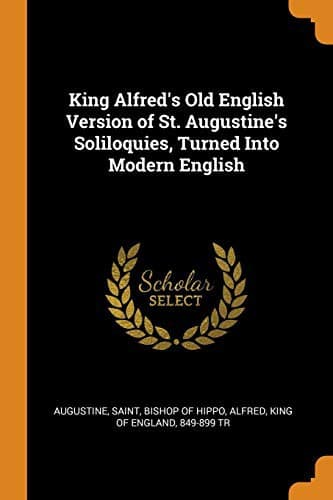
King Alfred's Old English Version of St. Augustine's Soliloquies: Turned into Modern English — John Shaqi
King Alfred's Old English Version of St. Augustine's Soliloquies: Turned into Modern EnglishAugustine, of Hippo, Saint
ReligionChristian
King Alfred's Old English Version of St. Augustine's Soliloquies: Turned into Modern English
Augustine, of Hippo, Saint
Knowledge, Theory of (Religion) -- Early works to 1800
_A._ Cease, O cease! Do not vex me, nor increase my sorrow. Enough have
I, though thou increase it not. _Thou seekest it at times so high, at
times so deep, that I understand now that I am not such as I supposed,
but I am ashamed that I supposed that which was not. Truly enough thou
hast said. The Physician_ whom I wish to heal me knoweth how _sound my
eyes_ are. He knoweth what He wisheth to show me. To Him I commit
myself, and to His goodness I entrust myself. May He do unto me
according to His will! On Him I call, that He may make fast my soul to
Him. I will never again say that I have _sound eyes until I see wisdom
itself_.
_R._ I know no better advice for thee than thou formerly saidst. But
leave off woe and sorrow, _and be measurably happy_. Thou wert formerly
too immoderately sorrowful, _for sorrow injureth both mind and body_.
_A._ Thou wouldst restrain my weeping and my sorrow, and still I
perceive no limit to my misery and misfortunes. Thou bidst me leave off
sorrow lest I, _either in mind_ or in body, be weaker; yet I find no
strength, _either in mind_ or body, but am full nigh in despair. But I
beseech thee, if thou in any wise canst, to lead me by some shorter way,
somewhat nearer the light _of the understanding_ which I long ago
desired and yet could not come by in my ignorance; notwithstanding that
I may afterwards be ashamed to look again toward the darkness which I
formerly desired to forsake, if ever I draw nigh to the light.
_R._ Let us now end this book here properly, and name a shorter way in
another book, if we can.
_A._ Nay, nay; let us not leave this book yet until I am able to
understand that which we are after.
_R._ Methinks I ought to do as thou bidst me. Something draweth me on, I
know not what, _but I surmise it is the God thou seekest after_.
_A._ _Thanks be to Him that adviseth thee, and to thee also, if thou
praise Him._ Lead whither thou wilt: _I will follow after thee if I
can_.
[Sidenote: 49.19--52.2]
_R._ Methinks thou desirest still to know that same thing about God and
thy soul which thou didst formerly desire.
_A._ Yea, that alone I desire.
_R._ Wishest thou aught more? Wishest thou not to know truth?
_A._ How can I, without truth, know aught of truth, _or what wilt thou
say, without truth, that God is? For we hear it read in the Gospel that
Christ said that He is the way, the truth, and the life._
_R._ Rightly thou sayest; but I would know whether it seemeth to thee
that the true and truth are one [and the same thing].
_A._ Two things, methinks, they are, _just as wisdom is one thing, and
that which is wise is another_; and likewise chastity is one thing, and
that which is chaste is another.
_R._ Which, then, doth seem to thee better, the true or truth?
_A._ Truth; for all that is true is so because of truth; and every thing
that is chaste is so because of chastity; _and he who is wise is so
because of wisdom_.
Public-domain text, read in full here on John Shaqi.
Reviews
Reviews
No reviews yet
Be the first to share your thoughts on this work.
Join the Discussion
Join the discussion
Sign in to leave a comment or review.
Sign InorCreate an account