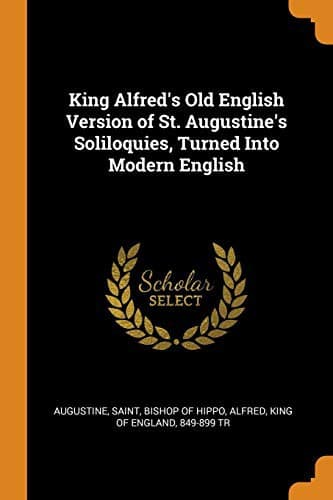
King Alfred's Old English Version of St. Augustine's Soliloquies: Turned into Modern EnglishAugustine, of Hippo, Saint
ReligionChristian
King Alfred's Old English Version of St. Augustine's Soliloquies: Turned into Modern English
Augustine, of Hippo, Saint
Knowledge, Theory of (Religion) -- Early works to 1800
_A._ That I both hear and believe, _and this instruction I will follow
as I best can_, and will pray God that I may fulfil it _as thou long ago
didst instruct me; do thou now teach me, if thou wilt_.
_R._ Do this for me first, and _tell me again, after thou hast studied
this, what thou likest of this; and if thou doubtest aught about any of
these things, then tell it to me_.
_Here endeth the anthology of the first book._
BOOK II
_Here beginneth the anthology of the second book._
_A._ Alas! Long have we been unoccupied, yet we have not sought after
_what thou didst promise me_.
_R._ _Let us make amends for it_; let us carry it forward into another
book.
_A._ Yea, let us indeed.
_R._ Let us believe that God is our Helper.
_A._ Truly would I that we believed it, if I had power. _But methinks
faith is not in our power, in such measure as we seek, unless_ God give
it to us.
_R._ _Both faith and all the good that we shall have. Therefore I know
not what else we can do without His help. Howbeit I advise thee that
thou begin it._ Pray in as few words as thou most sincerely canst, _and
ask for that which is and may be most needful for thee_.
_A._ _Then said I_: 'Lord, Lord, Thou who remainest unchangeable, grant
me these _two things which I always wished_, to wit, that I may
understand Thee and myself.' _Now I have done as thou didst instruct
me_; truly have I prayed.
_R._ _Now I hear what thou wishest to know. Howbeit I would first learn
from thee whether thou knowest without doubt_ that thou dost exist or
not; _or that thou dost live or dost not live_.
_A._ _These are two things which_ I certainly know.
_R._ What now wishest thou to know?
_A._ Whether I be immortal.
_R._ I hear that thou wouldst live always.
_A._ That I confess.
_R._ Wilt thou, then, know enough if I cause thee to know that thou
mayest live always?
[Sidenote: 56.13--58.22]
_A._ That is a very good desire; _yet say what I ask thee about: whether
I shall live always; and then I would know whether I, after the parting
of the body and the soul, shall ever know more than I now know of all
that which I have long wished to know; for I can not find any thing
better in man than that he know, and nothing worse than that he be
ignorant_.
_R._ Now I know all that thou wishest: One thing is, thou wouldst exist;
another, thou wouldst live; the third, thou wouldst know. And I know
also why thou wishest these three things: Thou wouldst exist in order to
live, and thou wouldst live in order to know. And these three things I
hear that thou certainly knowest: Thou knowest that thou art, and thou
knowest that thou livest, and thou also knowest that thou knowest
something, albeit thou knowest not all that thou wouldst know.
_A._ That is true. _These three things I know, and these three things I
desire. I would exist in order that I may live. What would I care
whether I existed, if I lived not? Or what would I care for life, if I
knew nothing?_
Public-domain text, read in full here on John Shaqi.
Reviews
Reviews
No reviews yet
Be the first to share your thoughts on this work.
Join the Discussion
Join the discussion
Sign in to leave a comment or review.
Sign InorCreate an account