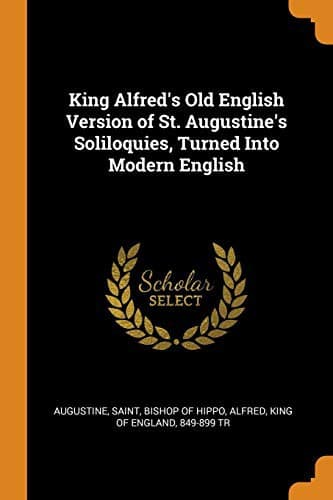
King Alfred's Old English Version of St. Augustine's Soliloquies: Turned into Modern EnglishAugustine, of Hippo, Saint
ReligionChristian
King Alfred's Old English Version of St. Augustine's Soliloquies: Turned into Modern English
Augustine, of Hippo, Saint
Knowledge, Theory of (Religion) -- Early works to 1800
_R._ _I hear now what thou wouldst know, but I can not tell thee in a
few words. If thou wilt know it clearly, then shalt thou seek it in the
book which we call_ De Videndo Deo. _In English the book is called_ Of
Seeing God. _But be now of good cheer, and think over what thou hast now
learned, and let us both pray that He may help us, for He promised that
He would aid every one who called on Him and rightly wished it; and He
promised without any doubt that He would teach us after this world that
we might very certainly know perfect wisdom and full truthfulness, which
thou mayest hear about more clearly in the book which I have before
named to thee_--De Videndo Deo.
_Here endeth the anthology of the second book which we call_
Soliloquies.
BOOK III
_Then said I: Now thou hast ended the sayings which thou hast selected
from these two books, yet hast not answered me about what I last asked
thee, to wit, about my intellect. I asked thee whether, after the
parting of body and soul, it would wax or wane, or whether it would do
both as it before did._
_R._ _Did I not say to thee before that thou must seek it in the book
which we then spake of? Learn that book, then thou wilt find it there._
_A._ _I do not care now to study all that book; but I would that thou
tell me that[12] ... the glory of the good, that their own torment may
seem the more to them, because they would not by their Father's advice
merit the same honors while they were in this world. And the good see
also the torments of the wicked in order that their own glory may seem
the more. The wicked see God as the guilty man who is condemned before
some king; when he seeth him and his own dear ones, then seemeth to him
his punishment the greater. And so also the dear ones of the king see
their punishment, so that their honors always may seem to them the
greater. No man ought to suppose that all those that are in hell have
like torments, nor that all those that are in heaven have like glory;
but every one hath according to his merits, punishment as well as glory,
whichever he is in. The like have their like. Moreover, it is not to be
supposed that all men have like wisdom in Heaven; for every one hath it
in the measure which he here merited. As he toileth better here and
better yearneth after wisdom and righteousness, so hath he more of it
there; likewise more honor and more glory. Hath it now been clearly
enough explained about wisdom and about the vision of God?_
[12] A break in the MS.
[Sidenote: 66.5--67.9]
Public-domain text, read in full here on John Shaqi.
Reviews
Reviews
No reviews yet
Be the first to share your thoughts on this work.
Join the Discussion
Join the discussion
Sign in to leave a comment or review.
Sign InorCreate an account