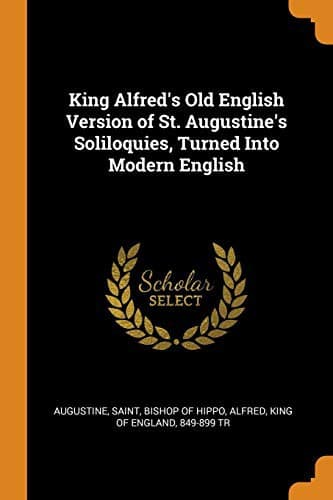
King Alfred's Old English Version of St. Augustine's Soliloquies: Turned into Modern English — John Shaqi
King Alfred's Old English Version of St. Augustine's Soliloquies: Turned into Modern EnglishAugustine, of Hippo, Saint
ReligionChristian
King Alfred's Old English Version of St. Augustine's Soliloquies: Turned into Modern English
Augustine, of Hippo, Saint
Knowledge, Theory of (Religion) -- Early works to 1800
O Lord, thou hast wrought all things perfect, and nothing imperfect; to
Thee is no creature untoward; though any thing will, it can not be so,
_for Thou hast shapen them all orderly, and peaceable, and so harmonious
that none of them can altogether destroy another, but the ugly ever
adorneth the beautiful_. To Thee I call, whom everything loveth that can
love, both those which know what they love, and those which know not
what they love. Thou who hast shapen all creatures very good, without
any evil--Thou who wilt not altogether _show thyself_ openly to any but
to them that are pure _in heart_, I call to Thee, O Lord, because Thou
art the Father of truth and wisdom, of the true and highest life, and of
the highest blessedness, and of the highest good, and of the highest
brightness, and of the intelligible light; _Thou who art the Father of
the Son who hath awakened us, and still arouseth us, from the sleep of
our sins_, and warneth us to come to Thee.
[Sidenote: 6.7--7.21]
To Thee I pray, O Lord, who art the highest truth, and through whom is
true all that is true. I pray to Thee, O Lord, who art the true life,
and through whom all things live that do live. Thou art the highest
blessedness, and through Thee are blessed all that are blessed. Thou art
the highest good[2] ... is and beautiful. Thou art the intelligible
light through which man knoweth. I pray to Thee, O Lord, who wieldest
all the world; whom we can not know bodily, _neither by eyes, nor by
smell, nor by ears, nor by taste, nor by touch_; although such laws as
we have, and such virtues as we have, we take _all those that are good_
from thy realm, _and from thy realm we draw an example of all the good
we perform_. For every one falleth who fleeth from Thee, and every one
riseth who turneth to Thee, and every one standeth who abideth in Thee;
he dieth who wholly forsaketh Thee, he is quickened who turneth to Thee,
and he liveth indeed who abideth in Thee. No one that is wise forsaketh
Thee, no one seeketh Thee except he be wise, and no one altogether
findeth Thee but the pure in heart. That is, he perisheth who forsaketh
Thee. _He who loveth Thee seeketh Thee; he who followeth after Thee hath
Thee. Thy truths which Thou hast given us awaken us from the sleep of
our sins._ Our hope lifteth us to Thee. Our love, which Thou hast given
us, bindeth us to Thee. Through Thee we overcome our foes, both
_spiritual and carnal_. Thou who forgivest, _draw nigh to me and have
mercy upon me_, because Thou hast bestowed upon us great gifts, to wit,
that we shall never entirely perish and thus come to naught.
[2] An omission in the MS.
Public-domain text, read in full here on John Shaqi.
Reviews
Reviews
No reviews yet
Be the first to share your thoughts on this work.
Join the Discussion
Join the discussion
Sign in to leave a comment or review.
Sign InorCreate an account