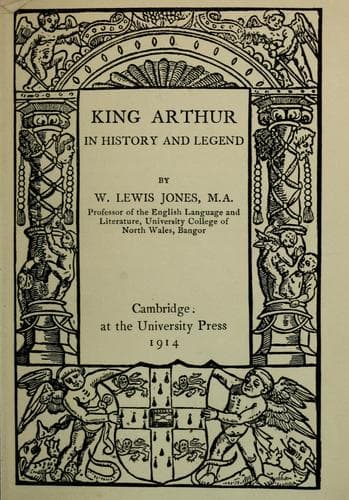
King Arthur in history and legendJones, William Lewis
History
King Arthur in history and legend
Jones, William Lewis
Arthur, King; Arthurian romances -- History and criticism
The meagreness of the pre-Norman Arthurian records which have been
here reviewed stands in significant contrast to the amplitude and
the range of the Arthurian matter which we find in the romantic
productions of the twelfth and thirteenth centuries. The contrast is
so startling as to suggest at once that the coming of the Normans to
Britain had much to do with what may be called the aggrandisation of
Arthur. It was Geoffrey of Monmouth, as we shall see, writing under the
direct auspices of a cultured Norman potentate, who did more than any
other man to spread the renown of Arthur as a presumably historical
character, and to give him for centuries an assured place in the
chronicle literature of Britain. But Geoffrey could not have written
“to order” such a book as his _History_ had he not a large stock of
popular traditions to draw upon. All the evidence seems to point to
the period extending from the tenth to the twelfth centuries as that
of the popular growth of an Arthurian legend, on a large scale, among
“the Celtic fringe.” By the beginning of the twelfth century Arthurian
stories were circulating freely in Brittany, Cornwall and Wales. It
is only on this supposition that one can account, for example, for a
tumult caused at Bodmin in the year 1113, by a certain monk from Laon
who had the temerity to deny that Arthur still lived.[40] Later on in
the same century, as Alanus de Insulis records,[41] belief in Arthur’s
“return” was so firmly held in the country districts of Brittany that a
denial of it might have cost a man his life. Moreover, two chroniclers
of repute who wrote before Geoffrey bear clear testimony to the
widespread currency of Arthurian traditions in their day, and to the
curiosity aroused in serious historians concerning the deeds of the
British king.
None of the Anglo-Norman chroniclers ranks higher as a trustworthy
historical authority than William of Malmesbury,--the first great
successor of Bede, whom he calls his master and exemplar. In the first
chapter of his _History of the Kings of England_--the first version of
which was completed in 1125--we find the following passage referring to
the Saxon invasions in the sixth century:--
“When he (Vortimer) died, the British strength decayed, and all hope
fled from them; and they would soon have perished altogether, had not
Ambrosius, the sole survivor of the Romans, who became monarch after
Vortigern, quelled the presumptuous barbarians by the powerful aid of
the warlike Arthur. This is the Arthur of whom the idle tales of the
Britons rave even unto this day; a man worthy to be celebrated not in
the foolish dreams of deceitful fables, but in truthful histories. For
he long sustained the declining fortunes of his native land, and roused
the uncrushed spirit of the people to war.”
Public-domain text, read in full here on John Shaqi.
Reviews
Reviews
No reviews yet
Be the first to share your thoughts on this work.
Join the Discussion
Join the discussion
Sign in to leave a comment or review.
Sign InorCreate an account