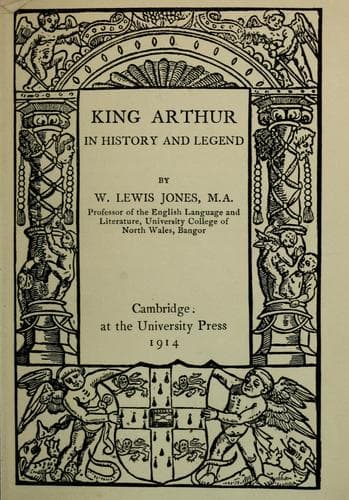
King Arthur in history and legendJones, William Lewis
History
King Arthur in history and legend
Jones, William Lewis
Arthur, King; Arthurian romances -- History and criticism
“Oftentimes in turning over in mine own mind the many themes that might
be subject-matter of a book, my thoughts would fall upon the plan of
writing a history of the Kings of Britain; and in my musings thereupon
meseemed it a marvel that, beyond such mention as Gildas and Bede
have made of them in their luminous tractate, nought could I find as
concerning the kings that had dwelt in Britain before the Incarnation
of Christ, _nor nought even as concerning Arthur_ and the many others
that did succeed him after the Incarnation, albeit that their deeds
be worthy of praise everlasting, and be as pleasantly _rehearsed from
memory by word of mouth in the traditions of many peoples_ as though
they had been written down. Now, whilst I was thus thinking upon such
matters, Walter, Archdeacon of Oxford, a man learned not only in the
art of eloquence, but in the histories of foreign lands, offered me a
certain most ancient book in the British language that did set forth
the doings of them all in due succession and order from Brute, the
first king of the Britons, onward to Cadwallader, the son of Cadwallo,
_all told in stories of exceeding beauty_. At his request, therefore,
albeit that never have I gathered gay flowers of speech in other men’s
little gardens and am content with mine own rustic manner of speech
and mine own writing-reeds, have I been at pains to translate this
volume into the Latin tongue. For, had I besprinkled my page with
high-flown phrases, I should only have engendered a weariness in my
readers by compelling them to spend more time over the meaning of the
words than upon understanding the drift of my story.”
Then follows the dedication to Robert of Gloucester.[76] Having thus
given us his authority, and having taken further shelter under the wing
of Walter, Geoffrey settles down to his task with all the gravity of a
pious monkish chronicler. As other chroniclers had done before him, he,
in his early books at least, makes brief references--as, apparently, so
many “guarantees of good faith”--to contemporaneous events in sacred
and profane history. When, for example, Gwendolen is said to have
handed over the sceptre to her son Maddan, we learn that “Samuel the
prophet reigned in Judæa, and Homer was held to be a famous teller of
histories and poet.” Carlisle, we are told, was founded at the time
when “Solomon began to build the temple of the Lord in Jerusalem.” “The
fortress of Mount Paladur, which is now called Shaftesbury,” was built
by Hudibras, when “Haggai, Amos, Joel and Azarias did prophesy.” We
get, in the account of the building of Shaftesbury, a characteristic
example of Geoffrey’s way of getting level with the sceptical reader.
“There, while the wall was a-building, an eagle spake, the sayings
whereof, had I believed them to be true, I would not have shrunk from
committing to memory along with the rest.”
Public-domain text, read in full here on John Shaqi.
Reviews
Reviews
No reviews yet
Be the first to share your thoughts on this work.
Join the Discussion
Join the discussion
Sign in to leave a comment or review.
Sign InorCreate an account