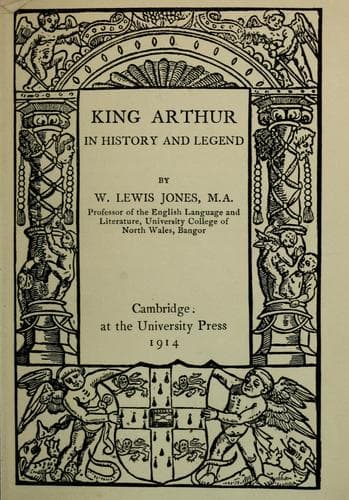
King Arthur in history and legendJones, William Lewis
History
King Arthur in history and legend
Jones, William Lewis
Arthur, King; Arthurian romances -- History and criticism
“Borne unto the island of Avalon for the healing of his wounds,”--here,
surely, are words never before used in a professedly historical
narrative of a kingly hero wounded unto death. This touch, alone, is
sufficient to attest the kinship of Geoffrey’s “history” of Arthur
with the waifs and strays of Celtic romance. The circumstances of
Arthur’s birth, as told by Geoffrey, were marvellous enough; like other
saga-heroes, such as Finn and Cormac, he was born out of wedlock,
through Merlin’s magical intervention. But what caught the imagination
of poets and romancers even more was the fable of his “return.” “Some
men say yet,” writes Malory, “that King Arthur is not dead, but had by
the will of our Lord Jesu into another place. And men say that he shall
come again, and he shall win the holy cross. I will not say it shall
not be so, but rather I will say, here in this world he changed his
life. But many men say that there is written upon his tomb this verse,
_Hic jacet Arthurus Rex quondam Rexque futurus_.” Later in the twelfth
century an attempt was made, at the instance--so it is alleged--of
Henry II to destroy the persistent belief in this “Celtic messiahship”
by an announcement that the body of Arthur had been exhumed at
Glastonbury by the monks of St Dunstan’s abbey.[82] It was, however, of
no avail. A poet of the next generation, Layamon, tells us that “the
Britons believe yet that Arthur is alive, and dwelleth in Avalon with
the fairest of all elves, and ever yet the Britons look for Arthur’s
coming.”
Public-domain text, read in full here on John Shaqi.
Reviews
Reviews
No reviews yet
Be the first to share your thoughts on this work.
Join the Discussion
Join the discussion
Sign in to leave a comment or review.
Sign InorCreate an account