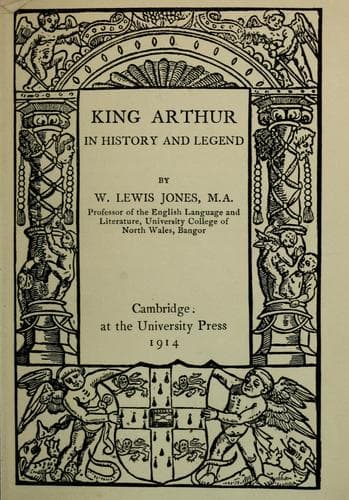
King Arthur in history and legendJones, William Lewis
History
King Arthur in history and legend
Jones, William Lewis
Arthur, King; Arthurian romances -- History and criticism
Although Geoffrey’s book found so much acceptance in his own time
and afterwards, it is significant to note that, even soon after its
appearance and in the very heyday of its repute, a few shrewd critics
ventured to question its authenticity. William of Newburgh, as we
have seen, denounced it unreservedly as a tissue of impudent lies.
He, at any rate, had no scruple in treating the work as a deliberate
experiment in fiction under the guise of a chronicle. A different
attitude towards the book might have been expected from Giraldus
Cambrensis, a Welshman proud of his race and of its “old and haughty”
traditions, who was himself not unskilled in the art of fiction. Yet it
is Gerald who, of all Geoffrey’s critics, says much the unkindest thing
on record of the _Historia_. He tells us of a Welshman at Caerleon
named Melerius, or Meilir, who had dealings with evil spirits, and was
“enabled through their assistance to foretell future events.” “He knew
when anyone spoke falsely in his presence, for he saw the devil as it
were leaping and exulting on the tongue of the liar.... If the evil
spirits oppressed him too much, the Gospel of St John was placed on his
bosom, when, like birds, they immediately vanished; but when that book
was removed, and the _History of the Britons_ by Geoffrey Arthur was
substituted in its place, they instantly reappeared in greater numbers,
and remained a longer time than usual on his body and on the book.”
Geoffrey, in the epilogue to his _History_, hands over the task of
writing of “the kings who succeeded in Wales” from the time at which
his narrative closes to “Caradoc of Llancarvan, my contemporary.”
Caradoc was an undoubted Welshman, but no Latin continuation by him
of Geoffrey’s chronicle dealing with the Welsh kings is known to
exist, and it is very doubtful whether a Welsh compilation bearing his
name, and bringing Geoffrey’s narrative down to the year 1156, is a
genuine work of his. It is, however, highly probable that he was the
author of the Latin _Life of Gildas_, preserved in a twelfth century
MS now in the library of Corpus Christi College, Cambridge. This work
is of peculiar interest as containing certain Arthurian traditions
which were apparently unknown to Geoffrey. Gildas is represented, in
this fictitious biography, as being a contemporary of Arthur, king of
all Britain, whom he loved and obeyed. He had, however, twenty-three
refractory brothers who refused allegiance to Arthur, and the eldest
of them, Hueil,[86] or Huel, King of Scotland, fought a battle with
him in “the isle of Minau” and was killed. Gildas, who was in Ireland
at the time, was much distressed to hear of this, but, as became a
saint, he prayed for Arthur, and, returning to Britain, granted the
king the pardon which he besought. Further on in the _Life_ we get a
version, probably the earliest in literature,[87] of the story of the
abduction of Guinevere by Melwas (the Mellyagraunce of Malory), “the
Public-domain text, read in full here on John Shaqi.
Reviews
Reviews
No reviews yet
Be the first to share your thoughts on this work.
Join the Discussion
Join the discussion
Sign in to leave a comment or review.
Sign InorCreate an account