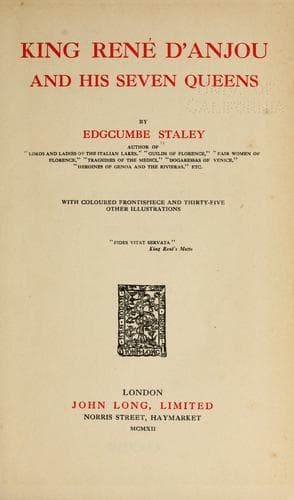
King René d'Anjou and His Seven QueensStaley, Edgcumbe
History
King René d'Anjou and His Seven Queens
Staley, Edgcumbe
France -- Court and courtiers; René I, King of Naples and Jerusalem, 1409-1480
The first notice we find of the life of Marie d’Anjou, however, does
not refer to her union with Charles VII., but her betrothal, when only
five years old, to Jehan de Beaux, Prince of Taranto, her kinsman.
He was the son of the Prince of Taranto who accompanied King Louis
II., Marie’s father, on his romantic journey to Perpignan, in 1399,
to welcome Princess Yolanda d’Arragona. Descended in direct line from
Charles, first Duke of Anjou, younger brother of St. Louis IX., his
grandfather was Philippe, second son of Charles III. and Marguerite
of France. Through the last-named Princess a sad stain besmirched
the shield of the silver lilies. Jehanne and Blanche de Luxembourg,
daughters of Otto IV., Count of Burgundy, married respectively King
Philippe the “Tall” and King Charles the “Fair” of France. Charged
with witchcraft, they were imprisoned for life in the Château de
Dourdan, where they were tonsured, scourged, and tortured--although
they were the most beautiful and most highly cultured women of their
day--together with their sister-in-law Marguerite, but she returned to
her husband in 1314. Their terrible experiences were made traditional
in the family, and, naturally, did not conduce to success in courtship.
No doubt the idea which fixed itself in the minds of Louis II. and
Yolande with respect to this betrothal was the strengthening of the
claims of Anjou, of the younger line, upon the crown of Naples, by the
alliance of the two branches of the house. Why this arrangement was set
aside, or when, it is hard to say. Some chroniclers aver that the young
Prince was drowned at sea off Taranto; others, that he had different
views; and, more likely than all, others attribute the renunciation to
the action of Queen Yolande, who, directly she had obtained charge of
the person of the young Dauphin Charles, determined a more brilliant
match politically, if a less attractive one psychologically.
Possibly Queen Yolande hardly realized, at the date of that auspicious
marriage, how its consummation would affect herself. High-toned as
she was, and assertive of Anjou’s prestige, she could not know that
Queen Isabeau’s absolute declension from rectitude would, by force of
contrast alone, throw her own worthy aims into emphatic prominence.
That marriage was the opening of the portals of imperial interest
to the personal guidance of the strongest mind and will in France.
She became actually the power on the throne, not behind it. Her hand
directed the issues of life and death between the rival Powers--France
and England. Yolande became at once the ruler of France and the
dictator of her foreign policy. What has history to say about all this?
Nothing, or next to nothing. Historians,--the most narrow-minded and
most easily biassed of writers,--have not cared to trace and teach the
ethics of the personality of this ruler of men and States.
Public-domain text, read in full here on John Shaqi.
Reviews
Reviews
No reviews yet
Be the first to share your thoughts on this work.
Elsewhere in the archive
Join the Discussion
Join the discussion
Sign in to leave a comment or review.
Sign InorCreate an account