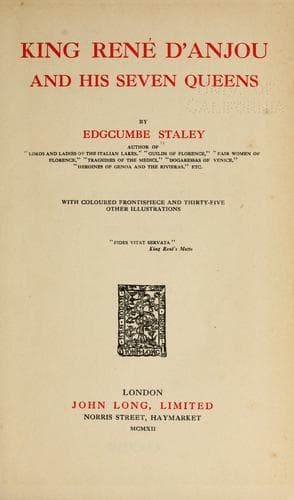
King René d'Anjou and His Seven QueensStaley, Edgcumbe
History
King René d'Anjou and His Seven Queens
Staley, Edgcumbe
France -- Court and courtiers; René I, King of Naples and Jerusalem, 1409-1480
The genesis of the paramount influence of women in the public and
private life of France was undoubtedly in the reign of Charles VII.
He was successively in the hands of Isabeau, his unworthy mother;
of Yolande, his noble mother-in-law; of Marie, his much-enduring
wife; and of Agnes Sorel, his inspiring mistress. Happily for him,
he was withdrawn early from the immediate care of Queen Isabeau, but
her intrigues later on brought out the latent bad elements of his
character. What saving grace was his, was his through Yolande of
Sicily-Anjou. His wife and his chief mistress were given him for two
distinct purposes: Marie kept the wolf from the door and emboldened
her faint-hearted spouse, whilst Agnes cheered his troubled spirit and
impelled his motive-power. There is a quatrain of Francis I. which is
interesting from the fact that his versification leaves it doubtful
whether Marie or Agnes was actually his good genius: he names _both_ in
the first line:
“Gentille Marie (Agnès), plus d’honneur tu mérite,
La cause étant de France recouvrer;
Que ce que peut dedans un cloître ouvrer--
Close nonain ou bien dévot hermite.”
“Gentle Marie (Agnes), thou hast gained all honour,
Of France the new life thou wast inspirer;
But thou wast born to adorn the cloister,
Encloséd nun or dedicated sister.”
Marie and René d’Anjou and Charles de Ponthieu were educated together,
and for four years or more were inseparable companions. The betrothal
of Charles and Marie was effected at the Palace of the Louvre, December
18, 1413, in the presence of the King and Queen of France and of the
King and Queen of Sicily-Anjou. Charles VI. was then still King of
France, and fully in possession of his senses. His troubles, political
and mental, ranged from 1417 to 1422, when he had become no more than
nominal Sovereign, driven from place to place, crushed, depressed,
and suffering. Until his malady became hopeless, he was noted for his
nobility of endurance, his chivalry of deportment, and his unselfish
devotion to his duty. His Don Quixotic sort of life, however, was a
mixture of smiles and frowns--joys and sorrows. Such a wife and mother
as Queen Isabeau proved herself to be was quite enough to shatter the
patience and the peace of the most stolid of men. There was not a more
unhappy family in all France than that of its principal Sovereign, nor
a more miserable home than that of its King.
Public-domain text, read in full here on John Shaqi.
Reviews
Reviews
No reviews yet
Be the first to share your thoughts on this work.
Elsewhere in the archive
Join the Discussion
Join the discussion
Sign in to leave a comment or review.
Sign InorCreate an account