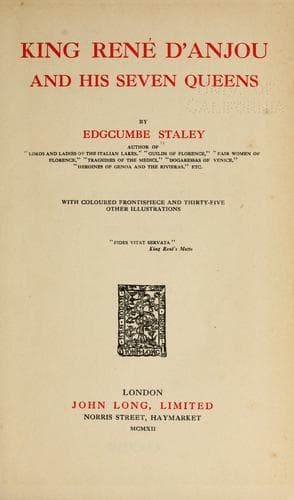
King René d'Anjou and His Seven Queens — John Shaqi
King René d'Anjou and His Seven QueensStaley, Edgcumbe
History
King René d'Anjou and His Seven Queens
Staley, Edgcumbe
France -- Court and courtiers; René I, King of Naples and Jerusalem, 1409-1480
At each of King René’s residences, and more especially at Aix, he
designed and erected a raised architectural loggia, or terrace, which
at once gained the name of _La Cheminée du Roy_. Here he was wont to
spend a good deal of his time in the enjoyment of the fresh air and
the contemplation of the persons and avocations of his subjects within
range. Here, too, he gave audience to all sorts and conditions of his
subjects, passing the time of the day merely to many, but with some
of them entering fully into matters proposed for his consideration.
Craftsmen, tradesmen, and merchants, were accustomed to pass that way
to expose commodities, and exhibit novelties which might tempt the
Royal patronage. One salient object of this amiable habit was that, as
he put it, “my children may see their father, and take cognizance of
my state of health and my pursuits.” René lived and worked among and
for his people, and none who approached him ever went away empty or
dissatisfied. Nothing pleased him better than a morning salutation or
an evening serenade by troubadour-jongleurs and other makers of music
and of fun. Sometimes the municipal authorities made courteous protests
to their liege Lord for the creation of crowds and obstruction to the
free circulation of the traffic. To all such representations the King
turned a ready ear, but also turned their pleas into subjects for
good-humoured merriment.
“You see,” he used to say, “I am something of a troubadour myself, and
life’s serious moods require joyous elevation.”
René was great in loving-cups, or, more correctly, their contents.
Nothing pleased him more than to hand to anyone who had interested
or amused him a delicious beverage, and often enough in the utmost
good-humour he bade the recipient keep the cup as a memento of his
interview--and “mind,” he added, “you drink my health and Queen
Jehanne’s sometimes.”
René’s consideration of and generosity to his servants and attendants
was proverbial. The _Comptes_ are full of instructions to his
Treasurers to pay such and such sums of money or other benefactions.
To Jehan de Sérancourt, an equerry, for example, he gave a purse of
200 ducats, “for thy skilful care of my favourite charger.” To Alain
le Hérault, a valet and barber “a gold snuffbox and fifty ducats for
his daughter’s confinement.” He was very fond of quoting the example of
Marie d’Harcourt, mother of his son-in-law Ferri de Vaudémont, who died
in 1476. She was affectionately called “the Mother of the Poor.” “She
was rightly called; am not I, then, father too?”
Public-domain text, read in full here on John Shaqi.
Reviews
Reviews
No reviews yet
Be the first to share your thoughts on this work.
Join the Discussion
Join the discussion
Sign in to leave a comment or review.
Sign InorCreate an account