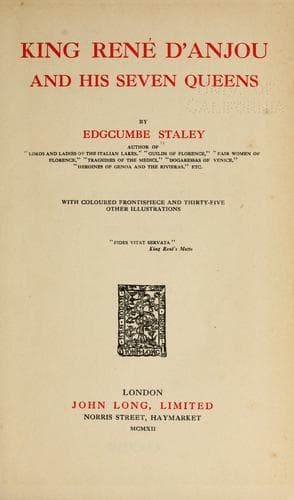
King René d'Anjou and His Seven Queens — John Shaqi
King René d'Anjou and His Seven QueensStaley, Edgcumbe
History
King René d'Anjou and His Seven Queens
Staley, Edgcumbe
France -- Court and courtiers; René I, King of Naples and Jerusalem, 1409-1480
René was a great collector of works of art and curios, although, by
the way, he was obliged very frequently to distribute his treasures
in order to raise money for his warlike enterprises and philanthropic
pursuits. A speciality was the acquisition of relics of saints and
other venerable objects. In 1470 he and Queen Jehanne assisted at the
translation of a piece of the True Cross, which he had obtained in
Italy, to the Church of St. Croix at Angers. Lists of such treasures,
and, indeed, of the treasures in general of his house, may be read in
_Les Comptes de Roy René_. Many originally came from King John the
“Good” of France, René’s great-grandfather, handed down by Louis I. and
Louis II. of Sicily-Anjou.
René had a penchant for rock-crystal objects and miniature carvings in
wood. Among the former he possessed a very famous winecup, upon which
he engraved the following quaint conceit:
“Qui bien beurra
Dieu voira.
Qui beurra tout d’une baleine
Voira Dieu et la Madeleine!”
“Whoso drinks me
God shall see.
Whoso at one good breath drains me
Shall God and the Magdalen see!”
CHAPTER II
YOLANDA D’ARRAGONA--“A GOOD MOTHER AND A GREAT QUEEN.”
I.
The Queen was in labour, and shivering groups of robust citizens and
sturdy peasants were gathered in front of the royal castle of Zaragoza,
eagerly awaiting the signal of a happy deliverance. The fervent wish of
King Juan for a male heir was shared by his subjects, for his brother
Martino, next in succession, was in delicate health; moreover, he had
only one son, and he was a cripple. The succession to the throne was a
source of anxiety to all good Aragonese. To be sure, there was a baby
Princess already in the royal nursery, but whether her mother had been
a lawful wedded wife, or no more than a _barragana_ of the Sovereign,
few knew outside the charmed circle of the Court. In the opinion of the
men and women of the triple kingdom generally, this mattered little,
for natural children were looked upon as strengthening the family;
_hijos de ganancia_ they were called. The Salic Law, however, barred
the female heirs of the royal house, so little Juanita was of no
importance.
[Illustration: YOLANDA D’ARRAGONA
(KING RENÉ’S MOTHER)
From Coloured Glass Window, Le Mans Cathedral
_To face page 30_]
Public-domain text, read in full here on John Shaqi.
Reviews
Reviews
No reviews yet
Be the first to share your thoughts on this work.
Join the Discussion
Join the discussion
Sign in to leave a comment or review.
Sign InorCreate an account