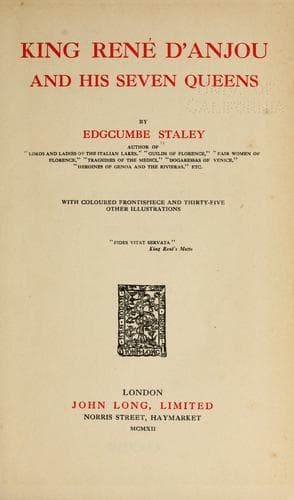
King René d'Anjou and His Seven QueensStaley, Edgcumbe
History
King René d'Anjou and His Seven Queens
Staley, Edgcumbe
France -- Court and courtiers; René I, King of Naples and Jerusalem, 1409-1480
The almost fairy Princess-Countess survived her consort many years,
and lived to see the county of Bar raised to a dukedom, and to dance
upon her knee a little namesake granddaughter, Violante de Bar. Nothing
gave her greater pleasure than the floral games of the troubadours, and
one of these _fêtes galants_ was enacted in 1363 at the Ducal Castle
of Val de Cassel, where Duchess Marie had just brought into the world
this very baby girl. The poets chose their laureate--one Eustache
Deschamps-Morel, and Princess Iolande crowned him with bays. The
_ballade_ he composed for those auspicious revels is still extant--_Du
Métier Profitable_--wherein he maintains that only two careers are open
to happy mortals.
“Ces deux ont partout l’avantage,
L’un en junglant, l’autre à corner.”
The sights and sounds, then, which first greeted the pretty child were
merry and tuneful. She was reared on troubadour fare, on troubadour
lore. Violante had three brothers, Édouard, Jehan, and Louis, and a
younger sister Bonne, married to Nicholas, Comte de Ligny, but alas!
buried with her first-born before the high-altar of St. Étienne at
Bar-le-Duc.
When Violante was in her seventeenth year, there came a royal
traveller, disguised as a troubadour of Languedoc, to the Court of Love
at Bar-le-Duc. His quest was for a bride. He was of ancient lineage;
his forbears came from Ria, in a southern upland valley of the Eastern
Pyrenees, and had ruled the land ’twixt barren mountain and wild
seacoast for no end of years--Juan I., King of Aragon, Catalonia, and
Valencia. He had just buried Mahaud d’Armagnac, the young mother of his
little daughter Juanita, and there was a gaping wound in his amorous
heart which yearned for healing. The royal Benedict looked for a Venus
with a dash of Diana and a measure of Minerva, and chroniclers say he
had drawn blank the Courts of Spain and Southern France. Moreover, they
tell a pretty tale of him which must now again be told.
After wanderings manifold, the royal knight-errant found himself
within the pageant-ground of Bar-le-Duc and at a “Court of Love.”
There he broke shield and lance at tilt, and Prince Cupid pierced
his heart. Mingling in the merry throng, King Juan found himself
partnered by the most beauteous damsel his eyes had ever seen. She
was the Princess Violante, daughter of the Duke. Before she realized
what her gay _vis-à-vis_ had said and done, he vanished. But upon her
maiden finger glittered a royal signet-ring. Back to Zaragoza sped
the gay troubadour, and in a trice a noble embassy was on its way to
the Barrois Court to claim the hand of the fascinating Princess and
to exchange the heavy ring of State for the lighter jewelled hoop of
espousal.
Public-domain text, read in full here on John Shaqi.
Reviews
Reviews
No reviews yet
Be the first to share your thoughts on this work.
Join the Discussion
Join the discussion
Sign in to leave a comment or review.
Sign InorCreate an account