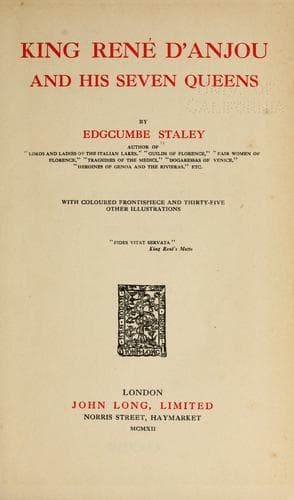
King René d'Anjou and His Seven QueensStaley, Edgcumbe
History
King René d'Anjou and His Seven Queens
Staley, Edgcumbe
France -- Court and courtiers; René I, King of Naples and Jerusalem, 1409-1480
Yolanda, Queen-consort of Juan I., King of the triple kingdom of
Aragon, Catalonia, and Valencia--Violante de Bar--was the elder of
the two daughters of Robert I., Duke of Bar, and his wife, Marie of
France, daughter of King John II., “the Good.” Their Court was one of
the chief resorts of the Troubadours and Jongleurs, who looked to the
Duke’s famous mother, Princess Iolande of Flanders, as their queen and
patroness. Bar, or Barrois, first gained royal honours when the Emperor
Otto III., in 958, created his son and successor, Frederic, Count of
Bar and Prince of the Holy Roman Empire. The succession was handed
down for hundreds of years, and in 1321 Count Henry IV. married the
Flemish Princess. Her jewels and her trousseau were the talk of half a
century. Her gaiety, her erudition, and her skill in handicraft, were
remarkable; her Court the most splendid in Europe.
Bar was, so to speak, the golden hub of the great humming wheel of
Franco-Flemish arts and crafts. Bordered by Luxembourg, Lorraine,
Champagne, and Burgundy, the fountain-heads of rich and generous
vintages, she took toll of all, and the Barroisiens were the
healthiest, wealthiest, and the merriest folk in the French borderland.
The influence of the bewitching and accomplished Princess-Countess
Iolande was paramount, and she was ever adding to her fame by making
royal progresses throughout her husband’s domains. Wherever she went,
music and the fine arts, and every artistic cult and useful craft,
prospered amazingly. Borne in a great swaying chariot, drawn by four
strong white Flemish horses, the magnificence of her cortège led on
one occasion, if not on more, nearly to her undoing. Travelling in the
summer-time of the year 1361 to Clermont en Argonne, one of the ducal
castles, she was, when not very far away from storied Laon, beset by
an armed company of outlaws, who, however, treated her with charming
courtesy. They caused the Princess and her ladies to descend from their
equipage and step it with them as _vis-à-vis_ under the greenwood tree.
Then, not very gallantly, to be sure, they stripped their fair partners
of their ornaments and despoiled the princely treasure, causing the
Princess to sign a pardon for their onslaught. The adventure, however,
did not end here, for Iolande was a match for any man, and on the spot
she enrolled her highwaymen as recruits for Count Henry’s army!
Public-domain text, read in full here on John Shaqi.
Reviews
Reviews
No reviews yet
Be the first to share your thoughts on this work.
Join the Discussion
Join the discussion
Sign in to leave a comment or review.
Sign InorCreate an account