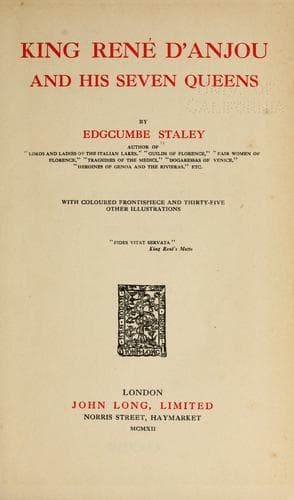
King René d'Anjou and His Seven QueensStaley, Edgcumbe
History
King René d'Anjou and His Seven Queens
Staley, Edgcumbe
France -- Court and courtiers; René I, King of Naples and Jerusalem, 1409-1480
Queen Yolanda most heartily seconded her consort’s project,--indeed,
she it was who had first suggested that line of action,--and when,
on May 15, the King breathed his last in the castle of his fathers
in Zaragoza, she claimed the succession for her son-in-law and
daughter. On the day following the King’s death she took the young
Princess,--barely thirteen years of age,--accompanied by the whole
Court and a crowd of sympathetic citizens, into the basilica of Sa Zeo,
and placed her upon the magnificent and historic silver throne of the
Kings of Aragon. Bending her knees before her, she kissed the child’s
hand in homage to her sovereignty, and caused heralds to proclaim her
“_Yolanda Reina d’Arragona_.” It was a bold step, but quite in accord
with the ruling instinct of the royal house; moreover, it commanded the
suffrages of very many members of the Cortes.
The Estates of the three realms met in plenary session, and before
the deliberations were opened the little “Queen” was presented by her
mother, who demanded a unanimous vote in favour of Louis and Yolanda.
There were, however, other claimants for the crown, and the Cortes
decided to offer it to Dom Martino, the late King’s only surviving
brother, a next heir-male of the blood, whose consort was Queen Maria
of Sicily. The new King treated his widowed sister-in-law and his
little niece with the utmost consideration. He prevailed upon Queen
Yolanda to retain the royal apartments at the castle, for he did not
propose to reside there. He only stayed at Zaragoza for his coronation,
and returned at once to Palermo.
The whole energy of the widowed Queen was now devoted to the education
of her only child. Her widowhood weighed lightly upon her; her buoyant,
happy nature soon shook off her grief and mourning. She was now
perfectly free to cultivate her tastes. If the “little Queen” was not
to be Queen of Aragon, she should succeed herself as “Queen of Hearts
and Troubadours.” Accordingly she moved her residence to Barcelona,
the sunny and the gay, and there at once set up a “Court of Love.”
Catalonia was times out of mind the rival of Provence in romance and
minstrelsy; her marts had quite as many merry troubadours as serious
merchants. The _corridas de toros_--bullfights--of Barcelona were the
most brilliant in Spain, whilst the people were as independent and as
unconventional as they were cultured and industrious. The two Queens
very soon became expert _aficionadas_ of the royal sport.
Public-domain text, read in full here on John Shaqi.
Reviews
Reviews
No reviews yet
Be the first to share your thoughts on this work.
Join the Discussion
Join the discussion
Sign in to leave a comment or review.
Sign InorCreate an account