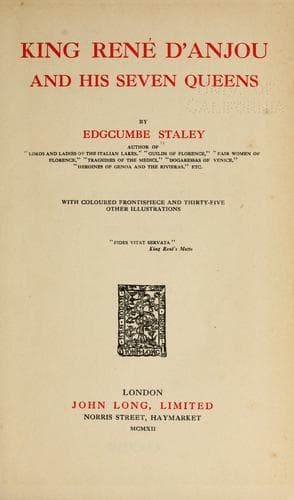
King René d'Anjou and His Seven QueensStaley, Edgcumbe
History
King René d'Anjou and His Seven Queens
Staley, Edgcumbe
France -- Court and courtiers; René I, King of Naples and Jerusalem, 1409-1480
Queen Yolanda never for a moment lost sight of the future of her
daughter, and preparations for her marriage to Louis d’Anjou occupied
very much of her busy, merry, useful life. Queens’ trousseaux were
something more than nine days’ wonders; besides, the ambition of
the mother-Queen knew no bounds to her daughter’s horizon. She
must go forth at least as richly clothed and dowered as any of her
predecessors. Goldsmiths, glass-blowers, cabinet-makers, saddlers,
silk-weavers, and potters,--none more accomplished and famous in
Europe than the artificers of Barcelona and Valencia,--were set to
work to fill the immense walnut marriage-chests of the bride-to-be.
Her jewels were superb,--no richer gold was known than the red gold of
Aragon,--the royal gems were unique, of Moorish origin, uncut. Years
passed quickly along, and Princess Yolanda kept her eighteenth birthday
with her mother in Barcelona. She was on the threshold of a new life.
II.
One glorious autumn morning in the good year 1399,--“good” because
“the next before a brand-new century,” as said the gossips of the
time,--a gallant cavalcade deployed down the battlemented approach to
the grim old castle of Angers. At its head, mounted upon a prancing
white Anjou charger, rode as comely a young knight as ever hoisted
pennoned lance to stirrup-lock. He was dressed in semi-armour,--the
armour of the “Lists.” His errand was not warlike, for knotted in his
harness were Cupid’s love-ribbons: he was a royal bridegroom-elect
speeding off to bring gaily home from distant Aragon his fair
betrothed. He had been knighted ten years before by his uncle, Charles
VI., at his coronation in Nôtre Dame in Paris, at which solemnity he
had,--a slim lad of twelve,--held proudly the stirrup of the Sovereign.
Louis II. d’Anjou, born at the Castle of Toulouse on October 7, 1377,
succeeded his father, Louis I., in 1389, and, like him, bore many
titles of sovereignty: King of Naples, Sicily, and Jerusalem; Duke of
Anjou, Calabria, Touraine, and Pouille; Grand Peer of France; Prince
of Capua; Count of Provence, Maine, Forcalquier, and Piemont; Lord of
Montpellier; and Governor of Languedoc and Guienne. His grandfather
was the brave but unfortunate King John “the Good” of France; his
grandmother, the beautiful but sorrowful Queen Bonne of Luxembourg and
Bohemia.
The boy-King carrouselled through the lumbering gates of Angers
that brilliant October morning between two trusty knights of his
household,--loyal lieges of their late King now devoted to the service
of the son. As valiant in deeds of war as discreet in affairs of State
were Raymond d’Agout and Jehan de Morien. All three bore the proud
cognizance of Sicily-Anjou,--the golden flying eagle,--and their silken
bannerets were sewn with the white lilies of the royal house of France.
A goodly retinue of mounted men followed the young King, guarding the
person and the costly bridal gifts which accompanied the royal lover’s
cortège.
Public-domain text, read in full here on John Shaqi.
Reviews
Reviews
No reviews yet
Be the first to share your thoughts on this work.
Join the Discussion
Join the discussion
Sign in to leave a comment or review.
Sign InorCreate an account