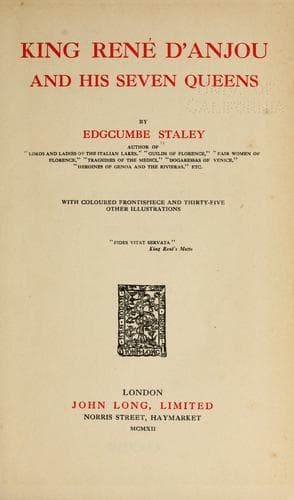
King René d'Anjou and His Seven QueensStaley, Edgcumbe
History
King René d'Anjou and His Seven Queens
Staley, Edgcumbe
France -- Court and courtiers; René I, King of Naples and Jerusalem, 1409-1480
The Angevine royal children were five in number, and Louis left
besides a natural son,--Louis de Maine, Seigneur de Mezières,--and
a natural daughter,--Blanche,--whom René, when he attained his
father’s throne in 1434, married to the Sieur Pierre de Biège. The
defunct King’s will appointed four simple knights,--his henchmen
true,--executors: Pierre de Beauvais and Guy de Laval for Anjou, and
Barthélèmy and Gabriel de Valorey for Provence, with Hardoyn de Bueil,
Bishop of Angers, as moderator. The Queen-mother was constituted Regent
of the kingdoms and dominions and guardian of the young King, whilst
Prince René was commended, under his father’s will, to the charge of
his great-uncle Louis, Cardinal and Duke de Bar, with the family title
of Comte de Guise.
[Illustration: KING LOUIS OF SICILY-ANJOU
(KING RENÉ’S FATHER)
From Coloured Glass Window, Le Mans Cathedral
_To face page 68_]
The loss of her second son and the parting of the brothers was a sore
trial to the whole family. The Cardinal, however, insisted upon his
young nephew being sent to him at Bar-le-Duc, to be educated under
his eye and prepared for his destiny as future Duke of Bar, which the
Cardinal caused to be announced both in Anjou and Barrois. Louis de
Bar was a very distinguished ecclesiastic; he had passed through every
grade of Holy Order with rare distinction. In 1391 the Pope conferred
upon him the bishopric of Poitiers, and two years later translated
him to Langres, with the Sees also of Châlons and Verdun. The latter
dignity carried with it the degree of Grand Peer of France, and in
those days Bishops were regarded as temporal Sovereigns within the
jurisdiction of their Sees. Benedict XIII. in 1397 preconized Louis
de Bar Cardinal-Bishop, and named him Papal Legate in France and
Germany. His temporal honours as Duke of Bar came to him in 1415, after
the calamitous battle of Azincourt, in which his two elder brothers,
Édouard and Jehan, fell gloriously. Their untimely deaths and disasters
keen and sad brought about, too, the death of good Duke Robert, their
father. He died of a broken heart, whilst Duchess Marie shut herself
up in a convent, and was never known again to smile. Her death has not
been recorded.
Public-domain text, read in full here on John Shaqi.
Reviews
Reviews
No reviews yet
Be the first to share your thoughts on this work.
Join the Discussion
Join the discussion
Sign in to leave a comment or review.
Sign InorCreate an account