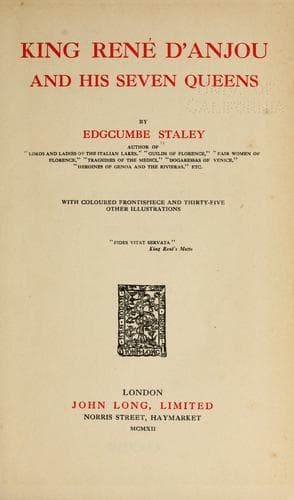
King René d'Anjou and His Seven QueensStaley, Edgcumbe
History
King René d'Anjou and His Seven Queens
Staley, Edgcumbe
France -- Court and courtiers; René I, King of Naples and Jerusalem, 1409-1480
After bidding adieu to her dearly loved son,--perhaps her favourite
child, and most like herself in temperament and character,--Queen
Yolande, with the young King, was fully occupied in receiving addresses
of condolence and assurances of loyalty both at Angers and at Aix, to
which they made a progress in full state. She assumed the personal
direction of affairs, appointing tactfully as assessors the most
prominent men of all classes in both domains. In a very distinct sense
she was a democratic Sovereign, and under her régime the Estates
were allowed a good deal of independent action in matters, at least,
of local policy. Thus, by maintaining the dignity of the crown of
Sicily-Anjou-Provence and encouraging popular government, Queen Yolande
initiated the first free constitution in the history of all France.
The stability of the throne and the welfare of its subjects having
been secured, the Queen turned her attention to the matrimonial
prospect of her eldest son. Some years before King Louis’s death, Jean
“sans Peur,” Duke of Burgundy,--in days when the Courts of Angers and
Dijon saw eye to eye, and the States were not rivals in the direction
of the general policy of the French Sovereigns,--had confided his
little daughter Catherine to the charge of the eminent Queen of
Sicily-Anjou, to be brought up with her own girls, the Princesses
Marie and Yolande. Then the idea of the betrothal of Louis d’Anjou
and Catherine de Bourgogne was accepted as a very excellent mutual
arrangement; indeed, the Duke had named his intention of dowering the
Princess with 50,000 _livres tournois_ (= _circa_ £30,000), besides
placing the castle at the disposal of the young couple upon the
consummation of the marriage.
There had arisen coolness and suspicion between the Sovereigns
of France and the Duke of Burgundy, whose connection with the
assassination of the Duke of Orléans, in 1407, had never been cleared
up. The Duke, moreover, had seen good,--in view of his professed claims
to the crown of France,--to make terms with the King of England which
would, under certain circumstances, gain territorial aggrandizement
for Burgundy, and ultimately the reversion to his family of the
royal title. This _rapprochement_ with the hated invader of Northern
France,--the foe at the gates of Anjou,--lead summarily to the
renunciation by the Angevine Sovereigns of all matrimonial affinities
between the Houses of Anjou and Burgundy. Little Princess Catherine was
sent home to Dijon, and the Duke scouted the Anjou alliance, and made
terms with Lorraine, a step which in another decade told disastrously
against the son of Queen Yolande.
Public-domain text, read in full here on John Shaqi.
Reviews
Reviews
No reviews yet
Be the first to share your thoughts on this work.
Join the Discussion
Join the discussion
Sign in to leave a comment or review.
Sign InorCreate an account