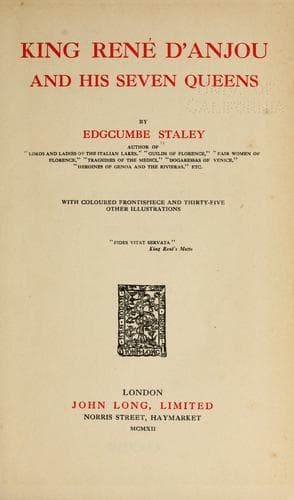
King René d'Anjou and His Seven QueensStaley, Edgcumbe
History
King René d'Anjou and His Seven Queens
Staley, Edgcumbe
France -- Court and courtiers; René I, King of Naples and Jerusalem, 1409-1480
The year before this precocious marriage the Cardinal had formally
proclaimed René his heir to the duchy of Bar, and created him Marquis
of Pont-à-Mousson. This action greatly displeased Arnould, Duke of
Berg, whose wife was Marie de Bar, a sister of the Cardinal. She
preferred claims to the succession as next of kin to her brother,
and when she was refused, the Duke took up arms and advanced upon
Bar-le-Duc. The movement failed, and young René saw the Duke’s dead
body taken away for burial without emotion. The young Prince had been
for nearly two years residing at his great-uncle’s castle, under
his immediate care and instruction. Among the tutors chosen for his
training were Maestre Jehan de Proviesey, a grammarian and Latinist,
and Maestre Antoine de la Salle, poet and musician. Such instructors
were _de rigueur_, of course, for the true development of a perfect
gentleman and courtier. The latter master wrote a treatise entitled
“_Les quinze joyes de la mariage: instructions addressés aux jeunes
hommes_.” This he dedicated to his pupil, Prince René. Among the quaint
aphorisms it contains, this must have caused more than a smile on the
part of the young knight:
“Bon cheval, mauvais cheval, veut l’esperon;
Bonne femme, mauvaise femme, veut le baston!”
Perhaps the pith of the treatise is expressed in the neat quintet:
“Quattuor sunt que mulieres summe cupiunt,
A formis amari juvenibus,
Pottere fillis pluribus
Ornari preciosis vestibus
Et dominari pre ceteris in domibus.”
René’s time was, however, not wholly absorbed by his studies in school
and Court, for he bestrode his warhorse like a man, and rode forth by
his great-uncle’s side on punitive expeditions against recalcitrant
vassals and against the incursions of freebooters, who under the
designation of “_Soudoyers_” were devastating the duchy. It was said of
the Cardinal: “_Il savait au besoin porter ung bassinet pour mitre et
pour croix d’or un tache d’acier_!”
Public-domain text, read in full here on John Shaqi.
Reviews
Reviews
No reviews yet
Be the first to share your thoughts on this work.
Join the Discussion
Join the discussion
Sign in to leave a comment or review.
Sign InorCreate an account