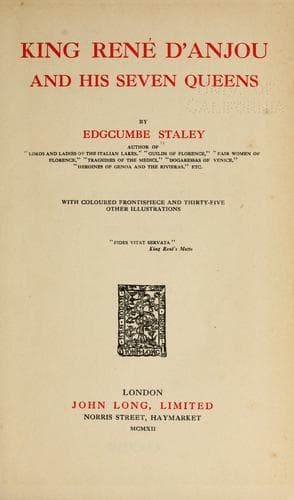
King René d'Anjou and His Seven Queens — John Shaqi
King René d'Anjou and His Seven QueensStaley, Edgcumbe
History
King René d'Anjou and His Seven Queens
Staley, Edgcumbe
France -- Court and courtiers; René I, King of Naples and Jerusalem, 1409-1480
Directly Duke Robert died, and the succession fell to an ecclesiastic,
the dissatisfied subjects of the Barrois crown considered it a
favourable opportunity for throwing off their allegiance. Jean
de Luxembourg, a cousin of the widowed Duchess Marie, and Robert
de Sarrebouche,--at the extreme limits of the territories of the
duchy,--were perhaps the most conspicuous for their infidelity. The
Cardinal-Duke struck home at once, and both rebels surrendered. In
the case of the latter, Prince René was put forward to receive his
submission, on his great-uncle’s behalf. The “proud Sieur de Commercy,”
as he was called, was compelled to kneel in the market-place of
Commercy before the boy-knight, and, putting his great hands between
the tender palms of his Prince, obliged to swear as _vostre homme
et vostre vassail_! The Prince’s bearing in this his first military
campaign was beyond all praise, and the Cardinal was delighted with his
chivalry. The Duke of Lorraine sent to compliment him upon his courage,
and his doting mother, Queen Yolande, held a ten-days festival at
Angers, and rang all the church bells in honour of her son’s baptism of
blood.
These exploits caused the youthful hero to carry himself proudly, and
greatly increased his self-conceit. This latter development had an
amusing and yet a very natural sequel. The Prince with his own hand,
under the instruction of Maestre Jehan de Proviesey, wrote letters
to all the leading men of Angers, Provence, Barrois, and Lorraine,
in which he enlarged upon the boldness of his conduct; and inditing
sententious maxims, he sought their approbation and good-will. The
Cardinal-Duke doubtless smiled good-humouredly at these juvenile
effusions, but at the same time he reconstituted the Barrois knightly
“_Ordre de la Fidélité_,” which embraced as members all the young
French Princes, and created René de Bar, as he was now called, first
and principal Knight. The Prince henceforward wore the motto of his
Order embroidered upon his _berretta_ and chimere--“_Tout Ung_”--and
chose it as his _gage de guerre_.
Public-domain text, read in full here on John Shaqi.
Reviews
Reviews
No reviews yet
Be the first to share your thoughts on this work.
Join the Discussion
Join the discussion
Sign in to leave a comment or review.
Sign InorCreate an account