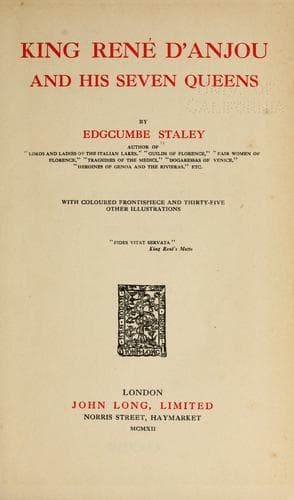
King René d'Anjou and His Seven QueensStaley, Edgcumbe
History
King René d'Anjou and His Seven Queens
Staley, Edgcumbe
France -- Court and courtiers; René I, King of Naples and Jerusalem, 1409-1480
The Cardinal clinched the matter, and paid a visit to the Duke of
Lorraine in furtherance of his project, which was the very natural
and sensible one of marrying his nephew René with the Duke’s eldest
daughter Isabelle. Whether Charles had any inklings of the Cardinal’s
cogitations with relation to his own position with respect to Bar we
know not; but possibly he had, for he met the proposition with a direct
refusal. He read to his relative two clauses of a will he had recently
executed, which forbade his daughter Isabelle to marry a Prince of
French origin, and especially barred the House of Anjou. This latter
prohibition was inserted with reference to the rupture between Jean
“sans Peur,” the Duke of Burgundy, and Louis II., King of Sicily and
Duke of Anjou, which resulted from the part the former had played in
the assassination of the Duke of Orléans in 1407, and the consequent
repudiation of the betrothal of Catherine de Bourgogne and Louis
d’Anjou. Lorraine and Burgundy were in close alliance.
The Cardinal, however, was not to be diverted from the course he
had taken. He placed ten considerations before the Duke and his
advisers:--(1) The advisability of reuniting the two portions of
Lorraine; (2) Charles’s lack of male heirs; (3) his own incompetence in
the same direction; (4) his choice of his grand-nephew, René d’Anjou,
as his successor at Bar-le-Duc; (5) the attractive personality, mental
attainments, and high courage of the young Prince; (6) his descent from
a Barrois-Lorraine Princess, Violante, his sister; (7) the risks of the
application of the power of the Salic Law over his daughters; (8) the
equality of age of René and Isabelle; (9) the wish of the late King and
of the Queen of Sicily-Anjou for an alliance with Lorraine and a better
understanding politically; (10) the welfare of the peoples of the two
duchies and the love of the Lorrainers for their princely house.
Charles asked time to consider these points, but meanwhile he summoned
the Estates, and laid before them a proposition concerning the
succession to Lorraine at his death. He named his eldest daughter as
Hereditary Duchess, and proposed that her consort should bear the
title, and with her exercise the prerogatives, of Duke of Lorraine. A
concordat was agreed to whereby the Estates were pledged to support the
Duchess Isabelle, and to carry out Charles’s wishes.
Public-domain text, read in full here on John Shaqi.
Reviews
Reviews
No reviews yet
Be the first to share your thoughts on this work.
Elsewhere in the archive
Join the Discussion
Join the discussion
Sign in to leave a comment or review.
Sign InorCreate an account