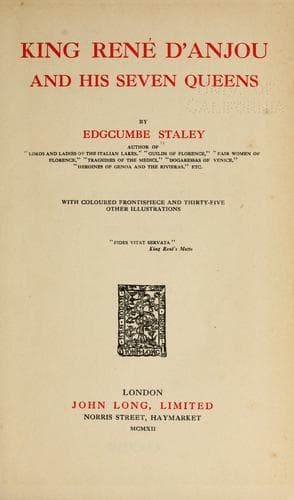
King René d'Anjou and His Seven QueensStaley, Edgcumbe
History
King René d'Anjou and His Seven Queens
Staley, Edgcumbe
France -- Court and courtiers; René I, King of Naples and Jerusalem, 1409-1480
Queen Yolande had seconded her uncle’s negotiations in a very womanly
and sensible way. She communicated directly with good Duchess Margaret.
She pointed out to her the mutual advantages of the marriage of the two
children, and declared that such a union would heal the breach between
the eastern and the western Sovereigns of France. Margaret, loving
peace and holy things, was easily persuaded to reason with her husband;
she submitted absolutely to the overpowering personality of the Queen.
With Charles, Yolande had a stiffer fight, but she gathered up her
strength, and in the end, lusty warrior that he was, he yielded up his
defence to the tactful diplomacy of the good mother of Anjou. Woman’s
wit once more, as it generally does, triumphed over man’s obstinacy.
Charles agreed to receive the young Prince, and judge for himself
of his prepositions and qualifications. The result was beyond the
Cardinal’s expectation, for the Duke declared himself charmed with
the boy. He was, he said, ready to rescind the prohibitory clauses of
his will, but he made it a condition that he should have the personal
and unrestricted guardianship of the boy until he reached the age of
fifteen. He desired René to proceed at once to Angers to obtain Queen
Yolande’s consent to the matrimonial contract between himself and
Princess Isabelle. Everything went merrily, like the marriage-bells
which soon enough pealed forth all over Lorraine, Barrois, and Anjou,
at the auspicious nuptials. The final arrangements were completed, and
René and Isabelle were betrothed at the Castle of St. Mihiel, and on
October 20, 1420, married at the Cathedral of Nancy by the Bishop of
Toul, Henri de Ville, Duke Charles’s cousin. Immediately before the
wedding, Cardinal-Duke Louis caused a herald to proclaim publicly, in
the market-place of Nancy, René d’Anjou, Comte de Guise, Hereditary
Duke of Bar, with the _ad interim_ title of Marquis of Pont-à-Mousson.
The record of the marriage is thus entered in “_Les Chroniques de
Lorraine_”: “_Les nopces furent faictes en grant triomphe, et la
dicte fille menée à Bar moult honorablement. Le Cardinal fust moult
joyeulx._”[A] The contract had been signed on March 20, 1420, by
the Duke and the Cardinal at the Château de Tourg, near Toul, Queen
Yolande’s signature being provided by her proxy. She granted to her son
the right to quarter the arms of Bar and Lorraine with those of Anjou
and Guise.
[A] “The nuptials were celebrated with great ceremony, and
the said Princess was conducted to Bar very honourably. The
Cardinal was full of joy.”
Public-domain text, read in full here on John Shaqi.
Reviews
Reviews
No reviews yet
Be the first to share your thoughts on this work.
Elsewhere in the archive
Join the Discussion
Join the discussion
Sign in to leave a comment or review.
Sign InorCreate an account