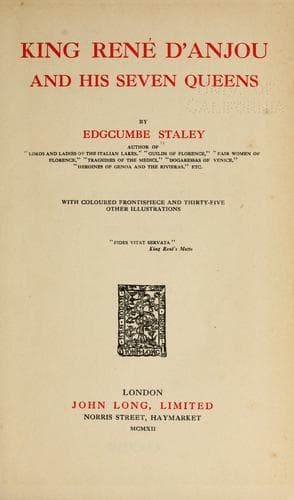
King René d'Anjou and His Seven QueensStaley, Edgcumbe
History
King René d'Anjou and His Seven Queens
Staley, Edgcumbe
France -- Court and courtiers; René I, King of Naples and Jerusalem, 1409-1480
He was famous as a Sovereign, a soldier, a legislator, a traveller,
a linguist, a scholar, a poet, a musician, a craftsman, a painter, an
architect, a sculptor, a collector, a sportsman, an agriculturist, and
incidentally a chivalrous lover. About such a many-sided character
there is much to tell and much to learn. His times were spacious;
the clouds of Mediævalism had rolled away, and the Sun of Progress
illuminated the heyday of the Renaissance; art and craft had come into
their own. Venus disarmed Mars, Diana entranced Apollo, and Minerva
restrained Mercury, and all the hierarchy of heaven was captive to
the Liberal Arts. René d’Anjou, figuratively, seems to have gathered
up in his cunning hand the powers of all the spiritual intelligences
alongwith the life-lines of practical manifestations. He has come down
to us as the beau-ideal Prince of the fifteenth century.
“A Prince who had great and pre-eminent qualities, worthy of a better
future. He was a great Justicier and an enemy to long despatches. He
said sometimes, when they presented anything to signe, being a-hunting
or at the warre, that the Pen was a kinde of Armes, which a person
should use at all times”--so wrote the historian Pierre Mathieu, in his
“History of Louis XI.,” in 1614. He goes on to say: “The reign of so
good a Prince was much lamented, for he intreated his subjects like a
Pastor and a Father. They say that when his Treasurer brought unto him
the Royale Taxe,--which was sixteen florins for every kindled fire,
whereof Provence might have about three thousand five hundred,--hee
enformed himselfe of the aboundance or barenesse of the season; and
when they told him, that a mistrall winde had reigned long, hee
remitted the moiety and sometimes the whole taxe. Hee contented himself
with his revenues, and did not charge his people with new tributes. Hee
spent his time in paintings, the which were excellent, as they are yet
to be seen in the city of Aix. Hee was drawing of a partridge when as
they brought him newes of the loose of the Realme of Naples, yet hee
could not draw his hande from the work and the pleasure hee took here
in.… They relate that he dranke not wine, and when as the noble men of
Naples demanded the reasons, he affirmed that it had made Titus Livius
to lie, who had said that the good wine caused the French to passe the
Alps.… He was perhaps better suited to make a quiet State happy than to
reduce a rebellious one.”
King René’s career and work as a Sovereign, a soldier, a legislator, a
traveller, a poet, and a lover, are treated in full in the letterpress
of this volume. His work as an artist, a craftsman, an agriculturist,
and a collector, is here given under different headings, as
introductory to the expression of his personal talents.
I. ARTISTIC WORKS OF KING RENÉ.
Public-domain text, read in full here on John Shaqi.
Reviews
Reviews
No reviews yet
Be the first to share your thoughts on this work.
Join the Discussion
Join the discussion
Sign in to leave a comment or review.
Sign InorCreate an account