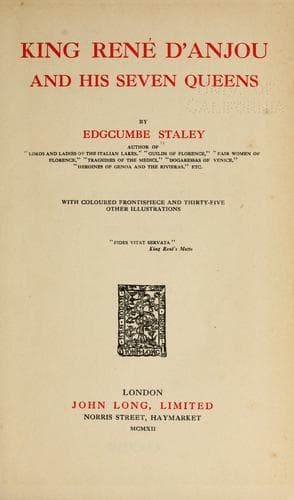
King René d'Anjou and His Seven QueensStaley, Edgcumbe
History
King René d'Anjou and His Seven Queens
Staley, Edgcumbe
France -- Court and courtiers; René I, King of Naples and Jerusalem, 1409-1480
René’s first efforts as a designer and painter were exhibited upon the
walls of his prison-chamber at Tour de Bar, near Dijon, 1431-1435.
Thence forward he decorated the walls and stain-glazed the windows of
his various castles and palaces--Bar-le-Duc, Nancy, Angers, Saumur,
Reculée, Tarascon, Marseilles, and Aix. Every _bastide_ and _maison_
inhabited by his Queens and himself was also similarly adorned, and
many coloured church windows were due to his gentle art. Alas that
so few vestiges of these admirable labours remain! French mobs are
proverbial for iconoclastic propensities, and no land has suffered more
than France from the suicidal mania of her _sans-culottes_.
To fresco-painting, portraits, and glass-staining, the Royal artist
added miniatures and penmanship. His “style” was formed and developed
successively under such personal tuition as that of the brothers Van
Eyck and Maistre Jehannot le Flament. Later on Jean Focquet of Tours
and Nicholas Froment influenced him. A letter is extant of King René,
addressed in 1448 to Jan Van Eyck, in which he asks for two good
painters to be sent to Barrois.
Visits to Rome, Florence, Naples, Milan, and other art cities of Italy,
very greatly enlarged René’s _métier_. Intercourse with Fra Angelico
da Fiesole, Fra Filippo Lippi, Paolo Ucello, the Della Robbia, and
many other Tuscan artists, quickened his natural talent and guided
his eye and hand. Leon Battista Alberti, Francesco Brunellesco, and
Cennino Cennini, and their works in _materia_ and literature, produced
great results in the receptive faculties of the King-artist. At Naples
he came in contact with Colantonio del Fiore, Antonio Solario--_Il
Zingaro_--and Angiolo Franco, and gathered up what they taught.
Besides these immense advantages as a personal friend of great ruling
Italian families, the Medici, the Pazzi, the Tornabuoni, the Visconti,
the Sforza, the Orsini, and many others, René had opportunities enjoyed
by very few. His own amiable individuality and his ample knowledge
were the highest credentials in the pursuit of art and craft. René
witnessed the consecration of the Duomo of Florence and the completion
of the guild shrine of Or San Michele, and he was enrolled as an
honorary member thereof. At Florence also he was thrown in contact with
world famous _scrivani_--writers and illustrators of manuscript. The
subsequent excellence of French miniaturists was largely due to King
René’s example and encouragement.
René’s more considerable paintings, which have been preserved, are as
follows:
1. _The Burning Bush_, part of an altar triptych, at the Cathedral
of Aix. Projected and begun by the King, it was finished by Nicholas
Froment, 1475-76, and for it the artist received no more than 70 gulden
(see illustration).
Public-domain text, read in full here on John Shaqi.
Reviews
Reviews
No reviews yet
Be the first to share your thoughts on this work.
Join the Discussion
Join the discussion
Sign in to leave a comment or review.
Sign InorCreate an account