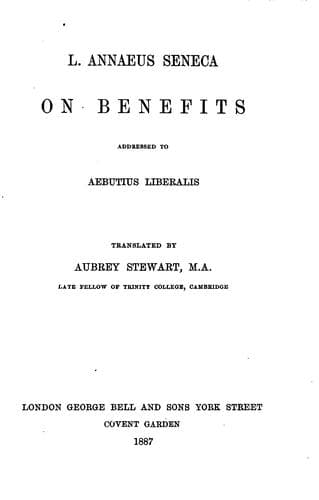
L. Annaeus Seneca on BenefitsSeneca, Lucius Annaeus
Philosophy
L. Annaeus Seneca on Benefits
Seneca, Lucius Annaeus
Benevolence; Classical literature; Conduct of life; Essays
XXXV. When I promise to bestow a benefit, I promise it, unless something
occurs which makes it my duty not to do so. What if, for example, my
country orders me to give to her what I had promised to my friend? or if
a law be passed forbidding any one to do what I had promised to do for
him? Suppose that I have promised you my daughter in marriage, that
then you turn out to be a foreigner, and that I have no right of
intermarriage with foreigners; in this case, the law, by which I
am forbidden to fulfil my promise, forms my defence. I shall be
treacherous, and hear myself blamed for inconsistency, only if I do not
fulfil, my promise when all conditions remain the same as when I made
it; otherwise, any change makes me free to reconsider the entire case,
and absolves me from my promise. I may have promised to plead a cause;
afterwards it appears that this cause is designed to form a precedent
for an attack upon my father. I may have promised to leave my country,
and travel abroad; then news comes that the road is beset with robbers.
I was going to an appointment at some particular place; but my son's
illness, or my wife's confinement, prevented me. All conditions must be
the same as they were when I made the promise, if you mean to hold me
bound in honour to fulfil it. Now what greater change can take place
than that I should discover you to be a bad and ungrateful man? I
shall refuse to an unworthy man that which I had intended to give him
supposing him to be worthy, and I shall also have reason to be angry
with him for the trick which he has put upon me.
XXXVI. I shall nevertheless look into the matter, and consider what the
value of the thing promised may be. If it be trifling, I shall give it,
not because you are worthy of it, but because I promised it, and I shall
not give it as a present, but merely in order to make good my words
and give myself a twitch of the ear. I will punish my own rashness in
promising by the loss of what I gave. "See how grieved you are; mind you
take more care what you say in future." As the saying is, I will take
tongue money from you. If the matter be important, I will not, as
Maecenas said, let ten million sesterces reproach me. I will weigh the
two sides of the question one against the other: there is something in
abiding by what you have promised; on the other hand, there is a great
deal in not bestowing a benefit upon one who is unworthy of it. Now, how
great is this benefit? If it is a trifling one, let us wink and let it
pass; but if it will cause me much loss or much shame to give it, I had
rather excuse myself once for refusing it than have to do so ever after
for giving it. The whole point, I repeat, depends upon how much the
thing given is worth: let the terms of my promise be appraised. Not only
shall I refuse to give what I may have promised rashly, but I shall also
demand back again what I may have wrongly bestowed: a man must be mad
who keeps a promise made under a mistake.
Public-domain text, read in full here on John Shaqi.
Reviews
Reviews
No reviews yet
Be the first to share your thoughts on this work.
Elsewhere in the archive
Join the Discussion
Join the discussion
Sign in to leave a comment or review.
Sign InorCreate an account