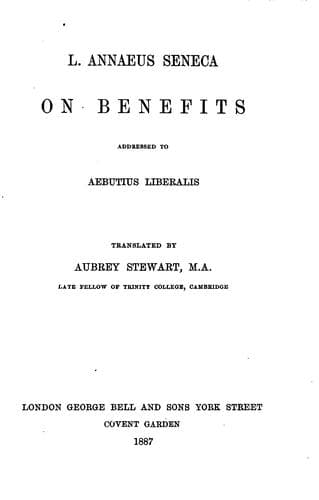
L. Annaeus Seneca on BenefitsSeneca, Lucius Annaeus
Philosophy
L. Annaeus Seneca on Benefits
Seneca, Lucius Annaeus
Benevolence; Classical literature; Conduct of life; Essays
XXXVII. Philip, king of the Macedonians, had a hardy soldier whose
services he had found useful in many campaigns. From time to time he
made this man presents of part of the plunder as the reward of his
valour, and used to excite his greedy spirit by his frequent gifts. This
man was cast by shipwreck upon the estate of a certain Macedonian,
who as soon as he heard the news hastened to him, restored his breath,
removed him to his own farmhouse, gave up his own bed to him, nursed him
out of his weakened and half-dead condition, took care of him at his own
expense for thirty days, restored him to health and gave him a sum of
money for his journey, as the man kept constantly saying, "If only I
can see my chief, I will repay your kindness." He told Philip of his
shipwreck, said nothing about the help which he had received, and at
once demanded that a certain man's estate should be given to him.
The man was a friend of his: it was that very man by whom he had been
rescued and restored to health. Sometimes, especially in time of war,
kings bestow many gifts with their eyes shut. One just man cannot deal
with such a mass of armed selfishness. It is not possible for any one
to be at the same time a good man and a good general. How are so many
thousands of insatiable men to be satiated? What would they have,
if every man had his own? Thus Philip reasoned with himself while he
ordered the man to be put in possession of the property which he asked
for. However, the other, when driven out of his estate, did not, like a
peasant, endure his wrongs in silence, thankful that he himself was not
given away also, but sent a sharp and outspoken letter to Philip, who,
on reading it, was so much enraged that he straightway ordered Pausanias
to restore the property to its former owner, and to brand that
wickedest of soldiers, that most ungrateful of guests, that greediest
of shipwrecked men, with letters bearing witness to his ingratitude. He,
indeed, deserved to have the letters not merely branded but carved in
his flesh, for having reduced his host to the condition in which he
himself had been when he lay naked and shipwrecked upon the beach;
still, let us see within what limits one ought to keep in punishing him.
Of course what he had so villainously seized ought to be taken from him.
But who would be affected by the spectacle of his punishment? The crime
which he had committed would prevent his being pitied even by any humane
person.
Public-domain text, read in full here on John Shaqi.
Reviews
Reviews
No reviews yet
Be the first to share your thoughts on this work.
Elsewhere in the archive
Join the Discussion
Join the discussion
Sign in to leave a comment or review.
Sign InorCreate an account