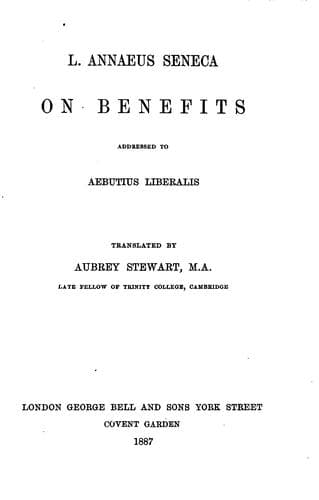
L. Annaeus Seneca on BenefitsSeneca, Lucius Annaeus
Philosophy
L. Annaeus Seneca on Benefits
Seneca, Lucius Annaeus
Benevolence; Classical literature; Conduct of life; Essays
XXXIV. "Many circumstances," argues he, "may arise which may enable a
bad man to steal into the place of a good one, or may cause a good man
to be disliked as though he were a bad one; for appearances, to which
we trust, are deceptive." Who denies it? Yet I can find nothing else by
which to guide my opinion. I must follow these tracks in my search after
truth, for I have none more trustworthy than these; I will take pains
to weigh the value of these with all possible care, and will not hastily
give my assent to them. For instance, in a battle, it may happen that my
hand may be deceived by some mistake into turning my weapon against my
comrade, and sparing my enemy as though he were on my side; but this
will not often take place, and will not take place through any fault of
mine, for my object is to strike the enemy, and defend my countryman.
If I know a man to be ungrateful, I shall not bestow a benefit upon him.
But the man has passed himself off as a good man by some trick, and has
imposed upon me. Well, this is not at all the fault of the giver, who
gave under the impression that his friend was grateful. "Suppose," asks
he, "that you were to promise to bestow a benefit, and afterwards were
to learn that your man was ungrateful, would you bestow it or not? If
you do, you do wrong knowingly, for you give to one to whom you ought
not; if you refuse, you do wrong likewise, for you do not give to him to
whom you promised to give. This case upsets your consistency, and that
proud assurance of yours that the wise man never regrets his actions,
or amends what he has done, or alters his plans." The wise man never
changes his plans while the conditions under which he formed them remain
the same; therefore, he never feels regret, because at the time nothing
better than what he did could have been done, nor could any better
decision have been arrived at than that which was made; yet he begins
everything with the saving clause, "If nothing shall occur to the
contrary." This is the reason why we say that all goes well with him,
and that nothing happens contrary to his expectation, because he
bears in mind the possibility of something happening to prevent the
realization of his projects. It is an imprudent confidence to trust that
fortune will be on our side. The wise man considers both sides: he knows
how great is the power of errors, how uncertain human affairs are, how
many obstacles there are to the success of plans. Without committing
himself, he awaits the doubtful and capricious issue of events, and
weighs certainty of purpose against uncertainty of result. Here also,
however, he is protected by that saving clause, without which he decides
upon nothing, and begins nothing.
Public-domain text, read in full here on John Shaqi.
Reviews
Reviews
No reviews yet
Be the first to share your thoughts on this work.
Elsewhere in the archive
Join the Discussion
Join the discussion
Sign in to leave a comment or review.
Sign InorCreate an account