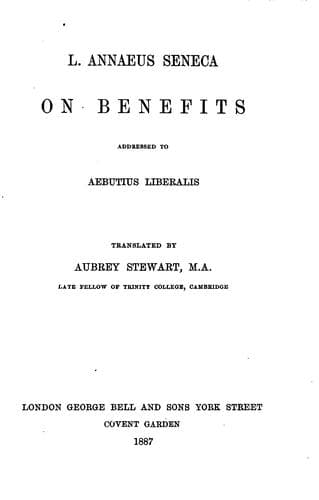
L. Annaeus Seneca on BenefitsSeneca, Lucius Annaeus
Philosophy
L. Annaeus Seneca on Benefits
Seneca, Lucius Annaeus
Benevolence; Classical literature; Conduct of life; Essays
XXXVIII. Will Philip then give you a thing because he has promised to
give it, even though he ought not to do so, even though he will commit
a wrong by doing so, nay, a crime, even though by this one act he will
make it impossible for shipwrecked men to reach the shore? There is no
inconsistency in giving up an intention which we have discovered to
be wrong and have condemned as wrong; we ought candidly to admit, "I
thought that it was something different; I have been deceived." It is
mere pride and folly to persist, "what I once have said, be it what
it may, shall remain unaltered and settled." There is no disgrace in
altering one's plans according to circumstances. Now, if Philip had
left this man in possession of that seashore which he obtained by
his shipwreck, would he not have practically pronounced sentence of
banishment against all unfortunates for the future? "Rather," says
Philip, "do thou carry upon thy forehead of brass those letters, that
they may be impressed upon the eyes of all throughout my kingdom. Go,
let men see how sacred a thing is the table of hospitality; show them
your face, that upon it they may read the decree which prevents its
being a capital crime to give refuge to the unfortunate under one's
roof. The order will be more certainly respected by this means than if I
had inscribed it upon tablets of brass."
XXXIX. "Why then," argues our adversary, "did your Stoic philosopher
Zeno, when he had promised a loan of five hundred denarii to some
person, whom he afterwards discovered to be of doubtful character,
persist in lending it, because of his promise, though his friends
dissuaded him from doing so?" In the first place a loan is on a
different footing to a benefit. Even when we have lent money to an
undesirable person we can recall it; I can demand payment upon a certain
day, and if he becomes bankrupt, I can obtain my share of his property;
but a benefit is lost utterly and instantly. Besides, the one is the act
of a bad man, the other that of a bad father of a family. In the next
place, if the sum had been a larger one, not even Zeno would have
persisted in lending it. It was five hundred denarii; the sort of sum of
which one says, "May he spend it in sickness," and it was worth paying
so much to avoid breaking his promise. I shall go out to supper, even
though the weather be cold, because I have promised to go; but I shall
not if snow be falling. I shall leave my bed to go to a betrothal feast,
although I may be suffering from indigestion; but I shall not do so if I
am feverish. I will become bail for you, because I promised; but not if
you wish me to become bail in some transaction of uncertain issue, if
you expose me to forfeiting my money to the state. There runs through
all these cases, I argue, an implied exception; if I am able, provided
it is right for me to do so, if these things be so and so. Make the
position the same when you ask me to fulfil my promise, as it was when
Public-domain text, read in full here on John Shaqi.
Reviews
Reviews
No reviews yet
Be the first to share your thoughts on this work.
Elsewhere in the archive
Join the Discussion
Join the discussion
Sign in to leave a comment or review.
Sign InorCreate an account