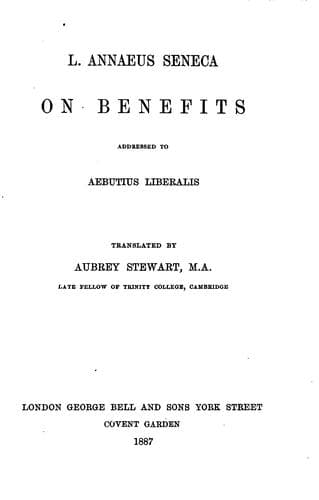
L. Annaeus Seneca on BenefitsSeneca, Lucius Annaeus
Philosophy
L. Annaeus Seneca on Benefits
Seneca, Lucius Annaeus
Benevolence; Classical literature; Conduct of life; Essays
I gave it, and it will be mere fickleness to disappoint you; but if
something new has taken place in the meanwhile, why should you wonder at
my intentions being changed when the conditions under which I gave the
promise are changed? Put everything back as it was, and I shall be the
same as I was. We enter into recognizances to appear, yet if we fail to
do so an action will not in all cases lie against us, for we are excused
for making default if forced to do so by a power which we cannot resist.
XL. You may take the same answer to the question as to whether we ought
in all cases to show gratitude for kindness, and whether a benefit ought
in all cases to be repaid. It is my duty to show a grateful mind, but
in some cases my own poverty, in others the prosperity of the friend
to whom I owe some return, will not permit me to give it. What, for
instance, am I, a poor man, to give to a king or a rich man in return
for his kindness, especially as some men regard it as a wrong to have
their benefits repaid, and are wont to pile one benefit upon another? In
dealing with such persons, what more can I do than wish to repay them?
Yet I ought not to refuse to receive a new benefit, because I have not
repaid the former one. I shall take it as freely as it is given, and
will offer myself to my friend as a wide field for the exercise of
his good nature: he who is unwilling to receive new benefits must be
dissatisfied with what he has already received. Do you say, "I shall
not be able to return them?" What is that to the purpose? I am willing
enough to do so if opportunity or means were given me. He gave it to me,
of course, having both opportunity and means: is he a good man or a bad
one? if he is a good man, I have a good case against him, and I will
not plead if he be a bad one. Neither do I think it right to insist on
making repayment, even though it be against the will of those whom we
repay, and to press it upon them however reluctant they may be; it is
not repayment to force an unwilling man to resume what you were once
willing to take. Some people, if any trifling present be sent to them,
afterwards send back something else for no particular reason, and then
declare that they are under no obligation; to send something back at
once, and balance one present by another, is the next thing to refusing
to receive it. On some occasions I shall not return a benefit, even
though I be able to do so. When? When by so doing I shall myself lose
more than he will gain, or if he would not notice any advantage to
himself in receiving that which it would be a great loss to me to
return. The man who is always eager to repay under all circumstances,
has not the feeling of a grateful man, but of a debtor; and, to put
it shortly, he who is too eager to repay, is unwilling to be in his
friend's debt; he who is unwilling, and yet is in his friend's debt, is
ungrateful.
BOOK V.
I.
Public-domain text, read in full here on John Shaqi.
Reviews
Reviews
No reviews yet
Be the first to share your thoughts on this work.
Elsewhere in the archive
Join the Discussion
Join the discussion
Sign in to leave a comment or review.
Sign InorCreate an account