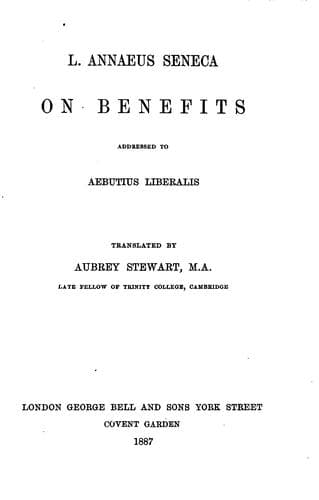
L. Annaeus Seneca on BenefitsSeneca, Lucius Annaeus
Philosophy
L. Annaeus Seneca on Benefits
Seneca, Lucius Annaeus
Benevolence; Classical literature; Conduct of life; Essays
who imitates another man's mode of speech, or is prepared to give praise
whether it be deserved or not; we ought equally to blame one who humours
himself and looks up to himself, and so to speak is his own flatterer.
Vices are not only hateful when outwardly practised, but also when they
are repressed within the mind. Whom would you admire more than he who
governs himself and has himself under command? It is easier to rule
savage nations, impatient of foreign control, than to restrain one's
own mind and keep it under one's own control. Plato, it is argued,
was grateful to Socrates for having been taught by him; why should not
Socrates be grateful to himself for having taught himself? Marcus Cato
said, "Borrow from yourself whatever you lack;" why, then, if I can
lend myself anything, should I be unable to give myself anything? The
instances in which usage divides us into two persons are innumerable; we
are wont to say, "Let me converse with myself," and, "I will give myself
a twitch of the ear;" [Footnote: See book iv. ch. xxxvi.] and if it be
true that one can do so, then a man ought to be grateful to himself,
just as he is angry with himself; as he blames himself, SO he ought
to praise himself; since he can impoverish himself, he can also enrich
himself. Injuries and benefits are the converse of one another: if we
say of a man, 'he has done himself an injury,' we can also say 'he has
bestowed upon himself a benefit?'
VIII. It is natural that a man should first incur an obligation, and
then that he should return gratitude for it; a debtor cannot exist
without a creditor, any more than a husband without a wife, or a son
without a father; someone must give in order that some one may
receive. Just as no one carries himself, although he moves his body and
transports it from place to place; as no one, though he may have made a
speech in his own defence, is said to have stood by himself, or erects
a statue to himself as his own patron; as no sick man, when by his
own care he has regained his health, asks himself for a fee; so in no
transaction, even when a man does what is useful to himself, need he
return thanks to himself, because there is no one to whom he can return
them. Though I grant that a man can bestow a benefit upon himself, yet
at the same time that he gives it, he also receives it; though I grant
that a man may receive a benefit from himself, yet he receives it at the
same time that he gives it. The exchange takes place within doors, as
they say, and the transfer is made at once, as though the debt were a
fictitious one; for he who gives is not a different person to he who
receives, but one and the same. The word "to owe" has no meaning except
as between two persons; how then can it apply to one man who incurs an
obligation, and by the same act frees himself from it? In a disk or
a ball there is no top or bottom, no beginning or end, because the
relation of the parts is changed when it moves, what was behind coming
Public-domain text, read in full here on John Shaqi.
Reviews
Reviews
No reviews yet
Be the first to share your thoughts on this work.
Elsewhere in the archive
Join the Discussion
Join the discussion
Sign in to leave a comment or review.
Sign InorCreate an account