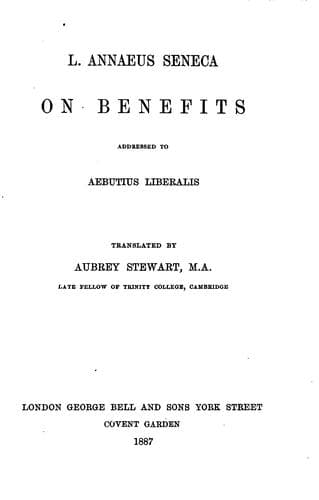
L. Annaeus Seneca on BenefitsSeneca, Lucius Annaeus
Philosophy
L. Annaeus Seneca on Benefits
Seneca, Lucius Annaeus
Benevolence; Classical literature; Conduct of life; Essays
This goes even further: according to this, crimes take the place of
benefits, and men do not shrink from shedding the blood of those for
whom they ought to shed their own; we requite benefits by steel and
poison. We call laying violent hands upon our own country, and putting
down its resistance by the fasces of its own lictors, gaining power
and great place; every man thinks himself to be in a mean and degraded
position if he has not raised himself above the constitution; the armies
which are received from the state are turned against her, and a general
now says to his men, "Fight against your wives, fight against your
children, march in arms against your altars, your hearths and homes!"
Yes, [Footnote: I believe, in spite of Gertz, that this is part of
the speech of the Roman general, and that the conjecture of Muretus,
"without the command of the senate," gives better sense.] you, who even
when about to triumph ought not to enter the city at the command of the
senate, and who have often, when bringing home a victorious army, been
given an audience outside the walls, you now, after slaughtering your
countrymen, stained with the blood of your kindred, march into the city
with standards erect. "Let liberty," say you, "be silent amidst the
ensigns of war, and now that wars are driven far away and no ground
for terror remains, let that people which conquered and civilized all
nations be beleaguered within its own walls, and shudder at the sight of
its own eagles."
XVI. Coriolanus was ungrateful, and became dutiful late, and after
repenting of his crime; he did indeed lay down his arms, but only in
the midst of his unnatural warfare. Catilina was ungrateful; he was
not satisfied with taking his country captive without overturning it,
without despatching the hosts of the Allobroges against it, without
bringing an enemy from beyond the Alps to glut his old inborn hatred,
and to offer Roman generals as sacrifices which had been long owing to
the tombs of the Gaulish dead. Caius Marius was ungrateful, when, after
being raised from the ranks to the consulship, he felt that he would not
have wreaked his vengeance upon fortune, and would sink to his original
obscurity, unless he slaughtered Romans as freely as he had slaughtered
the Cimbri, and not merely gave the signal, but was himself the signal
for civil disasters and butcheries. Lucius Sulla was ungrateful, for he
saved his country by using remedies worse than the perils with which it
was threatened, when he marched through human blood all the way from the
citadel of Praeneste to the Colline Gate, fought more battles and caused
more slaughter afterwards within the city, and most cruelly after the
victory was won, most wickedly after quarter had been promised them,
drove two legions into a corner and put them to the sword, and, great
gods! invented a proscription by which he who slew a Roman citizen
received indemnity, a sum of money, everything but a civic crown! Cnaeus
Public-domain text, read in full here on John Shaqi.
Reviews
Reviews
No reviews yet
Be the first to share your thoughts on this work.
Elsewhere in the archive
Join the Discussion
Join the discussion
Sign in to leave a comment or review.
Sign InorCreate an account