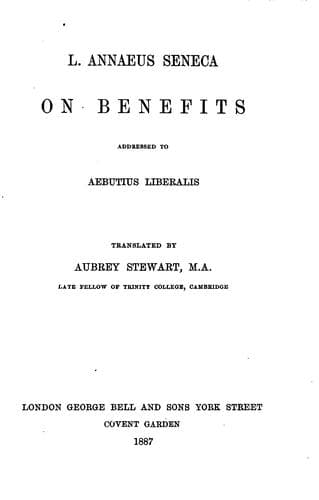
L. Annaeus Seneca on BenefitsSeneca, Lucius Annaeus
Philosophy
L. Annaeus Seneca on Benefits
Seneca, Lucius Annaeus
Benevolence; Classical literature; Conduct of life; Essays
Pompeius was ungrateful, for the return which he made to his country for
three consulships, three triumphs, and the innumerable public offices
into most of which he thrust himself when under age, was to lead others
also to lay hands upon her under the pretext of thus rendering his own
power less odious; as though what no one ought to do became right
if more than one person did it. Whilst he was coveting extraordinary
commands, arranging the provinces so as to have his own choice of them,
and dividing the whole state with a third person, [Footnote: Crassus.]
in such a manner as to leave two-thirds of it in the possession of his
own family, [Footnote: Pompey was married to Caesar's daughter. Cf.
Virg., "Aen.," vi., 831, sq., and Lucan's beautiful verses, "Phars.,"
i., 114.] he reduced the Roman people to such a condition that they
could only save themselves by submitting to slavery. The foe and
conqueror [Footnote: Seneca is careful to avoid the mention of Caesar's
name, which might have given offence to the emperors under whom
he lived, who used the name as a title.] of Pompeius was himself
ungrateful; he brought war from Gaul and Germany to Rome, and he, the
friend of the populace, the champion of the commons, pitched his camp in
the Circus Flaminus, nearer to the city than Porsena's camp had been. He
did, indeed, use the cruel privileges of victory with moderation; as was
said at the time, he protected his countrymen, and put to death no man
who was not in arms. Yet what credit is there in this? Others used their
arms more cruelly, but flung them away when glutted with blood, while
he, though he soon sheathed the sword, never laid it aside. Antonius was
ungrateful to his dictator, who he declared was rightly slain, and whose
murderers he allowed to depart to their commands in the provinces;
as for his country, after it had been torn to pieces by so many
proscriptions, invasions, and civil wars, he intended to subject it
to kings, not even of Roman birth, and to force that very state to pay
tribute to eunuchs, [Footnote: The allusion is to Antonius's connection
with Cleopatra. Cf. Virg. "Aen.," viii., 688.] which had itself restored
sovereign rights, autonomy, and immunities, to the Achaeans, the
Rhodians, and the people of many other famous cities.
Public-domain text, read in full here on John Shaqi.
Reviews
Reviews
No reviews yet
Be the first to share your thoughts on this work.
Elsewhere in the archive
Join the Discussion
Join the discussion
Sign in to leave a comment or review.
Sign InorCreate an account