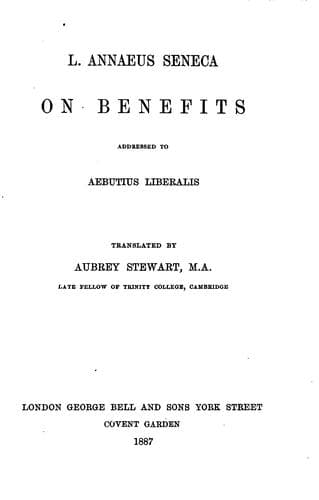
L. Annaeus Seneca on BenefitsSeneca, Lucius Annaeus
Philosophy
L. Annaeus Seneca on Benefits
Seneca, Lucius Annaeus
Benevolence; Classical literature; Conduct of life; Essays
The question is, whether one who has done everything in his power to
return a benefit, has returned it. "You may know," says our adversary,
"that he has not returned it, because he did everything in his power to
return it; it is evident, therefore, that he did not not do that which
he did not have an opportunity of doing. A man who searches everywhere
for his creditor without finding him does not thereby pay him what
he owes." Some are in such a position that it is their duty to effect
something material; in the case of others to have done all in their
power to effect it is as good as effecting it. If a physician has done
all in his power to heal his patient he has performed his duty; an
advocate who employs his whole powers of eloquence on his client's
behalf, performs his duty even though his client be convicted; the
generalship even of a beaten commander is praised if he has prudently,
laboriously, and courageously exercised his functions. Your friend has
done all in his power to return your kindness, but your good fortune
stood in his way; no adversity befell you in which he could prove the
truth of his friendship; he could not give you money when you were
rich, or nurse you when you were in health, or help you when you were
succeeding; yet he repaid your kindness, even though you did not receive
a benefit from him. Moreover, this man, being always eager, and on the
watch for an opportunity of doing this, as he has expended much anxiety
and much trouble upon it, has really done more than he who quickly had
an opportunity of repaying your kindness. The case of a debtor is not
the same, for it is not enough for him to have tried to find the money
unless he pays it; in his case a harsh creditor stands over him who will
not let a single day pass without charging him interest; in yours there
is a most kind friend, who seeing you busy, troubled, and anxious would
say.
"'Dismiss this trouble from thy breast;'
leave off disturbing yourself; I have received from you all that I wish;
you wrong me, if you suppose that I want anything further; you have
fully repaid me in intention."
"Tell me," says our adversary, "if he had repaid the benefit you would
say that he had returned your kindness: is, then, he who repays it in
the same position as he who does not repay it?"
On the other hand, consider this: if he had forgotten the benefit which
he had received, if he had not even attempted to be grateful, you would
say that he had not returned the kindness; but this man has laboured day
and night to the neglect of all his other duties in his devoted care to
let no opportunity of proving his gratitude escape him; is then he who
took no pains to return a kindness to be classed with this man who never
ceased to take pains? you are unjust, if you require a material payment
from me when you see that I am not wanting in intention.
Public-domain text, read in full here on John Shaqi.
Reviews
Reviews
No reviews yet
Be the first to share your thoughts on this work.
Elsewhere in the archive
Join the Discussion
Join the discussion
Sign in to leave a comment or review.
Sign InorCreate an account