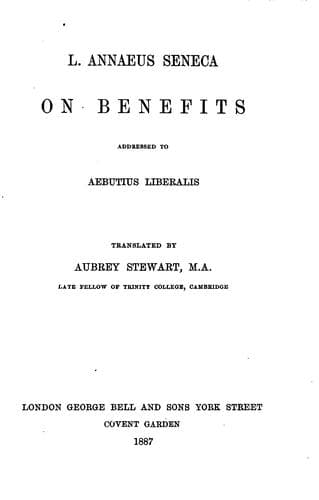
L. Annaeus Seneca on BenefitsSeneca, Lucius Annaeus
Philosophy
L. Annaeus Seneca on Benefits
Seneca, Lucius Annaeus
Benevolence; Classical literature; Conduct of life; Essays
XXIV. What then? would you not be captivated by the sight of such a
stupendous work, even though it did not cover you, protect you, cherish
you, bring you into existence and penetrate you with its spirit? Though
these heavenly bodies are of the very first importance to us, and are,
indeed, essential to our life, yet we can think of nothing but
their glorious majesty, and similarly all virtue, especially that of
gratitude, though it confers great advantages upon us, does not wish to
be loved for that reason; it has something more in it than this, and he
who merely reckons it among useful things does not perfectly comprehend
it. A man, you say, is grateful because it is to his advantage to be
so. If this be the case, then his advantage will be the measure of his
gratitude. Virtue will not admit a covetous lover; men must approach her
with open purse. The ungrateful man thinks, "I did wish to be grateful,
but I fear the expense and danger and insults to which I should expose
myself: I will rather consult my own interest." Men cannot be rendered
grateful and ungrateful by the same line of reasoning: their actions
are as distinct as their purposes. The one is ungrateful, although it is
wrong, because it is his interest; the other is grateful, although it is
not his interest, because it is right.
XXV. It is our aim to live in harmony with the scheme of the universe,
and to follow the example of the gods. Yet in all their acts the gods
have no object in view other than the act itself, unless you suppose
that they obtain a reward for their work in the smoke of burnt
sacrifices and the scent of incense. See what great things they do every
day, how much they divide amongst us, with how great crops they fill the
earth, how they move the seas with convenient winds to carry us to all
shores, how by the fall of sudden showers they soften the ground, renew
the dried-up springs of fountains, and call them into new life by
unseen supplies of water. All this they do without reward, without any
advantage accruing to themselves. Let our line of conduct, if it would
not depart from its model, preserve this direction, and let us not act
honourably because we are hired to do so. We ought to feel ashamed that
any benefit should have a price: we pay nothing for the gods.
Public-domain text, read in full here on John Shaqi.
Reviews
Reviews
No reviews yet
Be the first to share your thoughts on this work.
Elsewhere in the archive
Join the Discussion
Join the discussion
Sign in to leave a comment or review.
Sign InorCreate an account