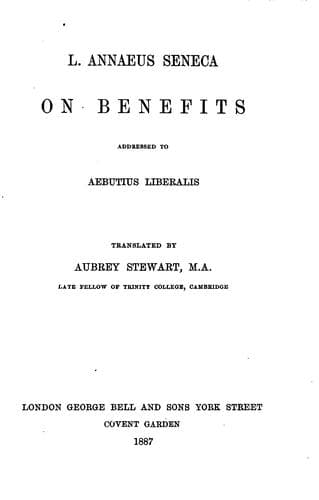
L. Annaeus Seneca on BenefitsSeneca, Lucius Annaeus
Philosophy
L. Annaeus Seneca on Benefits
Seneca, Lucius Annaeus
Benevolence; Classical literature; Conduct of life; Essays
another. How should the men of to-day know that ancient hero, who so
resolutely avoided the glory which pressed upon him, who went into
danger with the same look which other men wear when they have escaped
from danger, who never regarded his own interest as apart from that
of the commonwealth?" "Where," you ask, "or who is he? whence does
he come?" "You know him not; it lies with me to balance the debit and
credit account in such cases as these; I know how much I owe to each
man; I repay some after a long interval, others beforehand, according
as my opportunities and the exigencies of my social system permit."
I shall, therefore, sometimes bestow somewhat upon an ungrateful man,
though not for his own sake.
XXXIII. "What," argues he, "if you do not know whether your man be
ungrateful or grateful--will you wait until you know, or will you
not lose the opportunity of bestowing a benefit? To wait is a long
business--for, as Plato says, it is hard to form an opinion about the
human mind,--not to wait, is rash." To this objector we shall answer,
that we never should wait for absolute knowledge of the whole case,
since the discovery of truth is an arduous task, but should proceed
in the direction in which truth appeared to direct us. All our actions
proceed in this direction: it is thus that we sow seed, that we sail
upon the sea, that we serve in the army, marry, and bring up children.
The result of all these actions is uncertain, so we take that course
from which we believe that good results may be hoped for. Who can
guarantee a harvest to the sower, a harbour to the sailor, victory
to the soldier, a modest wife to the husband, dutiful children to the
father? We proceed in the way in which reason, not absolute truth,
directs us. Wait, do nothing that will not turn out well, form no
opinion until you have searched but the truth, and your life will pass
in absolute in action. Since it is only the appearance of truth, not
truth itself, which leads me hither or thither, I shall confer benefits
upon the man who apparently will be grateful.
Public-domain text, read in full here on John Shaqi.
Reviews
Reviews
No reviews yet
Be the first to share your thoughts on this work.
Elsewhere in the archive
Join the Discussion
Join the discussion
Sign in to leave a comment or review.
Sign InorCreate an account