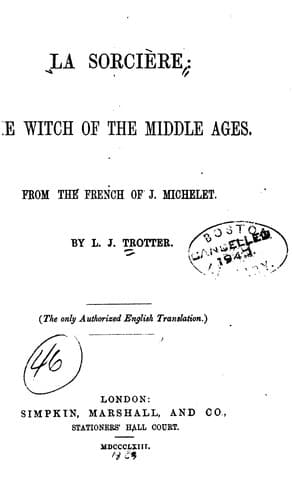
La Sorcière: The Witch of the Middle AgesMichelet, Jules
History
La Sorcière: The Witch of the Middle Ages
Michelet, Jules
Demonomania -- History -- To 1500; Satanism -- History -- To 1500; Superstition -- History -- To 1500; Witchcraft -- History -- To 1500
The man thus lost and done for, they made an end with the girls whom
it was not their part to burn. A farcical scene took place. In a large
gathering of the clergy and the Parliament, Madeline was made to
appear, and, in words addressed to herself, her devil Beelzebub was
summoned to quit the place or else offer some opposition. Not caring
to do the latter, he went off in disgrace.
Then Louisa, with her demon Verrine, was made to appear. But before
they drove away a spirit so friendly to the Church, the monks regaled
the Parliamentaries, who were new to such things, with the clever
management of this devil, making him perform a curious pantomime. “How
do the Seraphim, the Cherubim, the Thrones, behave before God?” “A
hard matter this:” says Louisa, “they have no bodies.” But on their
repeating the command, she made an effort to obey, imitating the
flight of the one class, the fiery longing of the others; and ending
with the adoration, when she bowed herself before the judges, falling
prostrate with her head downwards. Then was the far-famed Louisa, so
proud and so untamable, seen to abase herself, kissing the pavement,
and with outstretched arms laying all her length thereon.
It was a strange, frivolous, unseemly exhibition, by which she was
made to atone for her terrible success among the people. Once more she
won the assembly by dealing a cruel dagger-stroke at Gauffridi, who
stood there strongly bound. “Where,” said they, “is Beelzebub now, the
devil who went out of Madeline?” “I see him plainly at Gauffridi’s
ear.”
Have you had shame and horror enough? We should like further to know
what the poor wretch said, when put to the torture. Both the ordinary
and the extraordinary forms were used upon him. His revelations must
undoubtedly have thrown light on the curious history of the nunneries.
Those tales the Parliament stored up with greediness, as weapons that
might prove serviceable to itself; but it retained them “under the
seal of the Court.”
The inquisitor Michaëlis, who was fiercely assailed in public for an
excess of animosity so closely resembling jealousy, was summoned by
his order to a meeting at Paris, and never saw the execution of
Gauffridi, who was burnt alive four days afterwards, 30th April, 1611,
at Aix.
Public-domain text, read in full here on John Shaqi.
Reviews
Reviews
No reviews yet
Be the first to share your thoughts on this work.
Elsewhere in the archive
Join the Discussion
Join the discussion
Sign in to leave a comment or review.
Sign InorCreate an account