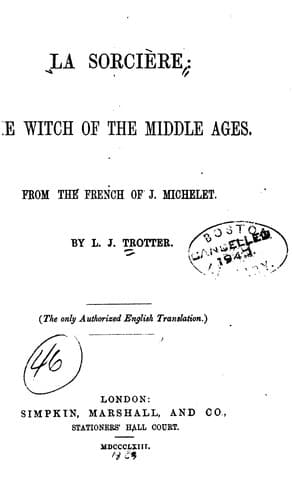
La Sorcière: The Witch of the Middle AgesMichelet, Jules
History
La Sorcière: The Witch of the Middle Ages
Michelet, Jules
Demonomania -- History -- To 1500; Satanism -- History -- To 1500; Superstition -- History -- To 1500; Witchcraft -- History -- To 1500
It must have amused him to see his trusty friends settled among honest
folk, in the serious households swayed by the Church. The worldling
who bettered himself by that great resource of the day, lucrative
adultery, laughed at prudence, and boldly followed his natural bent.
Pious families, on the other hand, followed nothing but their Jesuits.
In order to preserve, to concentrate their property, to leave each one
wealthy heir, they entered on the crooked ways of the new
spiritualism. Buried in a mysterious gloom, losing at the faldstool
all heed and knowledge of themselves, the proudest of them followed
the lesson taught by Molinos: “In this world we live to suffer. But in
time that suffering is soothed and lulled to sleep by a habit of pious
indifference. We thus attain to a negation. Death do you say? Not
altogether. Without mingling in the world, or heeding its voices, we
get thereof an echo dim and soft. It is like a windfall of Divine
Grace, so mild and searching; never more so than in moments of
self-abasement, when the will is wholly obscured.”
Exquisite depths of feeling! Alas, poor Satan! how art thou left
behind! Bend low, acknowledge, and admire thy children!
* * * * *
The physicians who, having sprung from the popular empiricism which
men called witchcraft, were far more truly his lawful children, were
too forgetful of him who had left them his highest patrimony, as being
his favoured heirs. They were ungrateful to the Witch, who laid the
way for themselves. Nay, they went further than that. On this fallen
king, their father and creator, they dealt some hard strokes with the
whip. “_Thou, too, my son?_” They gave the jesters cruel weapons
against him.
Even in the sixteenth century there were some to scoff at the spirit
who through all time, from the days of the Sibyl to those of the
Witch, had filled and troubled the woman. They maintained that he was
neither God nor Devil, but only “the Prince of the Air,” as the Middle
Ages called him. Satan was nothing but a disease!
_Possession_ to them was only a result of the prison-like, sedentary,
dry, unyielding life of the cloister. As for the 6500 devils in
Gauffridi’s little Madeline, and the hosts that fought in the bodies
of maddened nuns at Loudun and Louviers, these doctors called them
physical storms. “If Æolus can shake the earth,” said Yvelin, “why not
also the body of a girl?” La Cadière’s surgeon, of whom more anon, had
the coolness to say, “it was nothing more than a choking of the womb.”
Wonderful descent! Routed by the simplest remedies, by exorcisms after
Molière, the terror of the Middle Ages would flee away and vanish
utterly!
Public-domain text, read in full here on John Shaqi.
Reviews
Reviews
No reviews yet
Be the first to share your thoughts on this work.
Elsewhere in the archive
Join the Discussion
Join the discussion
Sign in to leave a comment or review.
Sign InorCreate an account