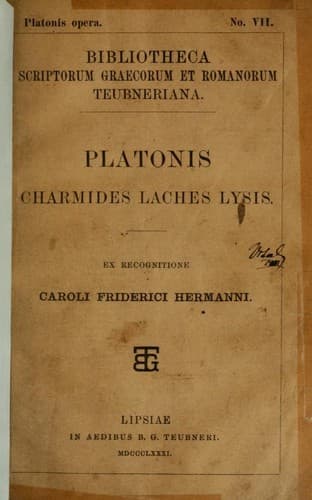
Classical literature; Courage -- Early works to 1800; Socrates, 470 BC-399 BC
NICIAS: Why, because he does not see that the physician's knowledge only
extends to the nature of health and disease: he can tell the sick man no
more than this. Do you imagine, Laches, that the physician knows whether
health or disease is the more terrible to a man? Had not many a man
better never get up from a sick bed? I should like to know whether you
think that life is always better than death. May not death often be the
better of the two?
LACHES: Yes certainly so in my opinion.
NICIAS: And do you think that the same things are terrible to those who
had better die, and to those who had better live?
LACHES: Certainly not.
NICIAS: And do you suppose that the physician or any other artist knows
this, or any one indeed, except he who is skilled in the grounds of fear
and hope? And him I call the courageous.
SOCRATES: Do you understand his meaning, Laches?
LACHES: Yes; I suppose that, in his way of speaking, the soothsayers are
courageous. For who but one of them can know to whom to die or to live
is better? And yet Nicias, would you allow that you are yourself a
soothsayer, or are you neither a soothsayer nor courageous?
NICIAS: What! do you mean to say that the soothsayer ought to know the
grounds of hope or fear?
LACHES: Indeed I do: who but he?
NICIAS: Much rather I should say he of whom I speak; for the soothsayer
ought to know only the signs of things that are about to come to pass,
whether death or disease, or loss of property, or victory, or defeat
in war, or in any sort of contest; but to whom the suffering or not
suffering of these things will be for the best, can no more be decided
by the soothsayer than by one who is no soothsayer.
LACHES: I cannot understand what Nicias would be at, Socrates; for he
represents the courageous man as neither a soothsayer, nor a physician,
nor in any other character, unless he means to say that he is a god. My
opinion is that he does not like honestly to confess that he is talking
nonsense, but that he shuffles up and down in order to conceal the
difficulty into which he has got himself. You and I, Socrates, might
have practised a similar shuffle just now, if we had only wanted to
avoid the appearance of inconsistency. And if we had been arguing in a
court of law there might have been reason in so doing; but why should
a man deck himself out with vain words at a meeting of friends such as
this?
SOCRATES: I quite agree with you, Laches, that he should not. But
perhaps Nicias is serious, and not merely talking for the sake of
talking. Let us ask him just to explain what he means, and if he has
reason on his side we will agree with him; if not, we will instruct him.
LACHES: Do you, Socrates, if you like, ask him: I think that I have
asked enough.
SOCRATES: I do not see why I should not; and my question will do for
both of us.
LACHES: Very good.
Public-domain text, read in full here on John Shaqi.
Reviews
Reviews
No reviews yet
Be the first to share your thoughts on this work.
Join the Discussion
Join the discussion
Sign in to leave a comment or review.
Sign InorCreate an account