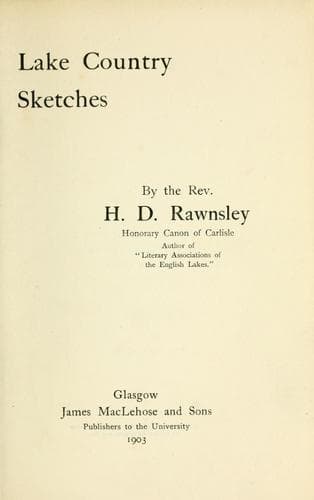
Lake country sketchesRawnsley, H. D. (Hardwicke Drummond)
General
Lake country sketches
Rawnsley, H. D. (Hardwicke Drummond)
Lake District (England); Wordsworth, William, 1770-1850 -- Homes and haunts -- England -- Lake District
Now and again as they fed, the whole flock would rise momentarily
into air and float up as though blown from the earth by some
invisible breath, and then, as silently and simultaneously, sink to
earth again.
{67}
At times one noticed how, rising up, they seemed to move in exactly
one position, moving their yellow rosy-stained beaks and grey heads
from right to left as though they feared an enemy. Yet they had no
need to fear, for it was quite clear that the rooks had been
specially engaged by them to be their sentinels. There they sat each
in solitary sable-hood, on the trees all round the lawn,--policemen
on guard, and of such good manners, that until the visitors from the
sea had eaten and were full, they did not think of claiming their
share of the broken victual.
What astonished one most as these black-headed gulls came morning
after morning to the sound of the gong, was their apparent
determination to lose no time about their food. They sat down to
table and rose up as one bird, but they were not more than ten
minutes about their meal, and there was some reason for this. There
were other breakfast tables spread for them on other lawns; the gong
at Derwent Hill was after all but summons to a first course.
How mild, how gentle, with what dove-like tenderness did these
grey-headed people of the sea appear as with merry laughter they
sailed about my head, their feet tucked {68} up like coral pink
jewels against their breast; how unlike those fierce black-headed
guardians of their nests and young, who had dashed at one, with open
beak and scolding voice and angry wing, upon the spring-tide dunes of
Ravenglass.
{69}
AT THE GRASMERE PLAY.
What a wonderful people these Westmoreland folk are; we see them on
the Wrestling Ground at Pavement end, and we think we never saw such
'playing.' We enter a Westmoreland dale farm, and we feel, if ever
men and women were born to make two ends meet by the care of sheep or
cattle, these are the people. We take lodgings in a Westmoreland
village for a holiday season, and though it may be quite true that
the landlady doesn't rave about the scenery, and is rather of the
type of the good woman-body who had lived at Rydal Mount before she
became lodging-house keeper, and who said to my friend, 'Yes, yes, I
am a tidy good cook and a decentish housekeeper, but I don't know
nowt about sunsets or sic like, and I don't need, they've never been
in my line,' it is at the same time true that, for looking after
one's creature wants and entering into the doings {70} of every day
and making one feel part and parcel of the household, a Westmorland
housekeeper is bad to beat.
Public-domain text, read in full here on John Shaqi.
Reviews
Reviews
No reviews yet
Be the first to share your thoughts on this work.
Join the Discussion
Join the discussion
Sign in to leave a comment or review.
Sign InorCreate an account