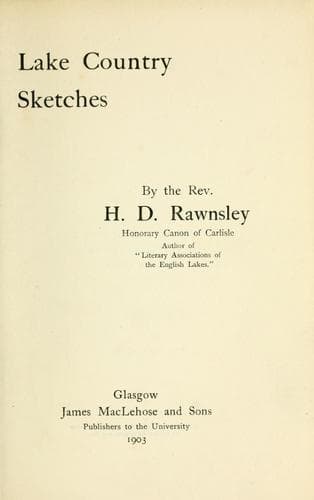
Lake country sketchesRawnsley, H. D. (Hardwicke Drummond)
General
Lake country sketches
Rawnsley, H. D. (Hardwicke Drummond)
Lake District (England); Wordsworth, William, 1770-1850 -- Homes and haunts -- England -- Lake District
But though I thought I knew the capacity of Westmoreland folk pretty
well, a new surprise was in store for me as I took my seat in the
temporary play-house at Grasmere and learned that Westmoreland folk
can not only play in the Grasmere wrestling ring, but can play on the
boards and before the footlights also. It is quite true that the
Grasmere people have had nearly a generation of training in the
dramatic art. A late rector, who was much interested in looking
after the recreations of the village, had translated for them many a
simple pastoral play from the French, and hardly a Christmas came
round, but he and his family, one of whom was herself a talented
writer of country plays, trained the villagers to give their
neighbours a play, and the children in the Bands of Hope to act
charades. Since his time another family who are much honoured at
Grasmere, and who have the same kind of enthusiasm for the dramatic
capacity of the village, had carried on the work, with the result
that at a moment's notice, for any simple play the daughter of the
house might write or adapt, she could count on having as her players
seventeen or eighteen of the {71} villagers who would seem born for
the parts she entrusted to them. There was no rivalry, no
'fratching' from house to house because this person or that person
was not selected for this or that particular part; on the contrary,
the village had such confidence in the conductor of the village
_troupe_ that if Miss S. thought that So-and-so was to take this part
and So-and-so the other, that was enough, and not another word was to
be said. Meanwhile the village had come to look upon the village
play as part of its very life and soul. Grasmere in winter time
would not be recognised by the average tourist. It is a village of
peace absolute and tranquillity beyond words.
From the earliest times 'Cursmas' has been looked upon as a time when
everybody in the dale should enjoy himself. In the old days, when
the fiddlers went round from farm to farm between Christmas-day and
New Year's Day, and when the Merry Night (or Murry Neet) was held
from place to place, the Grasmere folk knew that, however hard they
worked for the rest of the year, at least they would 'laike' until
the Twelfth Night, and precious little work would go forward in the
dales for the first fortnight of each glad new year. The desire for
some simple and rational form of {72} amusement with the beginning of
every year has never died out of their blood, so that a village play
seems to fill a need which is part of their very nature. 'Why, we
could not live without it,' said a Grasmere body to me; 'it's the
brightest spot in our lives.' 'I can't tell you how dramatic it
makes me feel,' said another. 'I am going thro' my dialogue at all
times o' day.' My husband said, 'You've had company to-day then.'
'Ay, ay,' I replied, 'rare company. I was taking two or three parts
in second Act, you see, and changing voices, that was all.'
Public-domain text, read in full here on John Shaqi.
Reviews
Reviews
No reviews yet
Be the first to share your thoughts on this work.
Join the Discussion
Join the discussion
Sign in to leave a comment or review.
Sign InorCreate an account