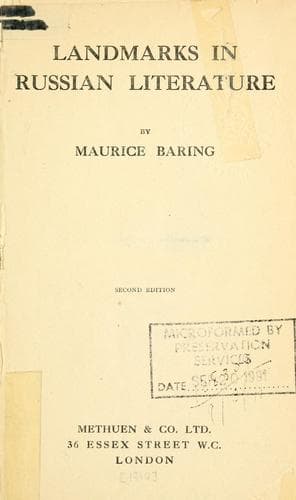
Russian literature -- 19th century -- History and criticism
With regard to the artistic construction of the book, the method is
the same as that of most of Dostoievsky’s books. In nearly all his
works the book begins just before a catastrophe and occupies the space
of a few days. And yet the book is very long. It is entirely taken
up by conversation and explanation of the conversation. There are no
descriptions of nature; everything is in a dialogue. Directly one
character speaks we hear the tone of his voice. There are no “stage
directions.” We are not told that so and so is such and such a person,
we feel it and recognise it from the very first word he says. On the
other hand, there is a great deal of analysis, but it is never of an
unnecessary kind. Dostoievsky never nudges our elbow, never points
out to us things which we know already, but he illuminates with a
strong searchlight the deeps of the sombre and tortuous souls of his
characters, by showing us what they are themselves thinking, but not
what he thinks of them. His analysis resembles the Greek chorus, and
his books resemble Greek tragedies in the making, rich ore mingled with
dark dross, granite and marble, the stuff out of which Æschylus could
have hewn another _Agamemnon_, or Shakespeare have written another
_King Lear_.
_The Idiot_ may not be the most artistic of all his books, in the sense
that it is not centralised and is often diffuse, which is not the case
with _Crime and Punishment_, but it is perhaps the most characteristic,
the most personal, for none but Dostoievsky could have invented and
caused to live such a character as Prince Mwishkin, and made him
positively radiate goodness and love.
VII
_THE POSSESSED_
_The Possessed_, or _Devils_, which is the literal translation of
the Russian title, is perhaps inferior to Dostoievsky’s other work
as a whole, but in one sense it is the most interesting book which
he ever wrote. There are two reasons for this: in the first place,
his qualities and his defects as a writer are seen in this book
intensified, under a magnifying glass as it were, at their extremes, so
that it both gives you an idea of the furthest range of his powers, and
shows you most clearly the limitations of his genius. Stevenson points
out somewhere that this is the case with Victor Hugo’s least successful
novels. In the second place, the book was far in advance of its time.
In it Dostoievsky shows that he possessed “a prophetic soul.”
The book deals with the Nihilists who played a prominent part in the
sixties. The explanation of the title is to be found in a quotation
from the 8th chapter of St. Luke’s Gospel.
Public-domain text, read in full here on John Shaqi.
Reviews
Reviews
No reviews yet
Be the first to share your thoughts on this work.
Elsewhere in the archive
Join the Discussion
Join the discussion
Sign in to leave a comment or review.
Sign InorCreate an account