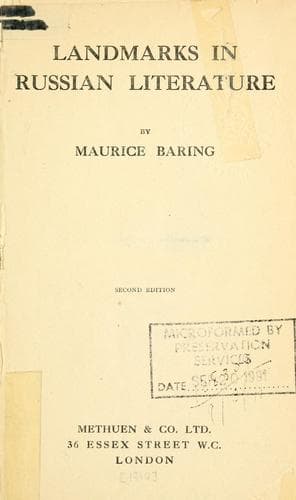
Russian literature -- 19th century -- History and criticism
“I have no modesty; that is my great defect.... I am ugly, awkward,
uncleanly, and lack society education. I am irritable, a bore to
others, not modest; intolerant, and as shamefaced as a child.... I am
almost an ignoramus. What I do know I have learnt anyhow, by myself,
in snatches, without sequence, without a plan, and it amounts to very
little. I am incontinent, undecided, inconstant, and stupidly vain
and vehement, like all characterless people. I am not brave.... I am
clever, but my cleverness has as yet not been thoroughly tested on
anything.... I am honest; that is to say, I love goodness.... There
is a thing I love more than goodness, and that is fame. I am so
ambitious, and so little has this feeling been gratified, that, should
I have to choose between fame and goodness, I fear I may often choose
the former. Yes, I am not modest, and therefore I am proud at heart,
shamefaced, and shy in society.”
At the time that Tolstoy wrote this he was a master, as Mr. Aylmer
Maude points out, of the French and German languages, besides having
some knowledge of English, Latin, Arabic, and Turco-Tartar. He had
published stories which had caused the editors of the best Russian
magazines to offer him the rate of pay accorded to the best-known
writers. Therefore his discontent with his position, both intellectual
and social, was in reality quite unfounded.
After the Crimean War, Tolstoy went abroad. He found nothing in Western
Europe to satisfy him. On his return he settled down at Yasnaya
Polyana, and married; and the great patriarchal phase of his life
began, during which every gift and every happiness that man can be
blessed with seemed to have fallen to his lot. It was then that he
wrote _War and Peace_, in which he describes the conflict between one
half of Europe and the other. He takes one of the largest canvases
ever attacked by man; and he writes a prose epic on a period full of
tremendous events. His piercing glance sees through all the fictions of
national prejudice and patriotic bias; and he gives us what we feel to
be the facts as they were, the very truth. No detail is too small for
him, no catastrophe too great. He traces the growth of the spreading
tree to its minute seed, the course of the great river to its tiny
source. He makes a whole vanished generation of public and private men
live before our eyes in such a way that it is difficult to believe that
these people are not a part of our actual experience; and that his
creations are not men and women we have seen with our own eyes, and
whose voices we have heard with our own ears.
Public-domain text, read in full here on John Shaqi.
Reviews
Reviews
No reviews yet
Be the first to share your thoughts on this work.
Join the Discussion
Join the discussion
Sign in to leave a comment or review.
Sign InorCreate an account